Showing posts with label sustainability. Show all posts

Tuesday, 1 September 2026

Awe and Care for Creation


On this World Day of Prayer for the Care of Creation, Pope Leo XIV calls on people worldwide to pray and act for a better world. We should “beat our swords into ploughshares and our spears into pruning hooks”. Just like in Isaiah’s time, our world is wounded by war and by “the disruption of the balance of Creation”. Climate change is a physical reality which calls all of us to think and to act. For Christians, the world was not just given to us, it was given to us with a purpose and a responsibility, comparable to the steward appointed to master the Father’s vineyard. Therefore, we are urged to intensify our prayers and our efforts to care for the planet and to establish God’s Kingdom.

The pope points out that ‘war’ and ‘war industry’ have disastrous effects on the environment. As a religious leader, he explains the deeper meaning of this ‘environment’. This environment is not limited to nature or to human structures, this environment goes all the way to the human heart. As a result, wars create vicious circles of hatred and violence, which can even lead to new wars. The solution to the problem, however, also resides in the human heart.

Real peace and real care for the creation can only be established through the conversion of the human heart. Only the conversion of the heart can change our daily attitude and our daily behaviour without force. We need to transform our world without the need of building new weaponry.

This World Day is only the beginning of an ecumenical Season of Creation proclaimed by many Christian churches. It starts today and ends at Saint Francis of Assisi remembrance day on October 4th. This initiative proves the Christian churches are capable of rediscovering their vocation in this world by observing present-day world challenges in a united way. And my prudent guess is that the care of creation observance period may find its rightful place in the liturgical year in the years to come.

I refer to my blogs Pray for Peace and Let so much suffering not be in vain.

Disclaimer: This is not a literal summary of Pope Leo’s letter. Although I believe to express the meaning of the letter in a faithful way, this text also contains some of my own free reformulations - interpretations of the Care for Creation letter.

Picture: made by Marie Lahaye in Berlin city gardens August 2026

Tuesday, 24 June 2025

The Secret of Simple Sound World Economics


In this merciless world, we observe chaos, corruption, trade barriers, extortion and exploitation of the weak. We wonder if there exists any solution to the unsurmountable problems of world economics. We acknowledge there will always be shortages. There is simply not enough for everybody on this planet.

Puzzled by these questions and by feelings of guilt two thousand years ago, people asked John the Baptist what they should be doing. You would expect a very demanding list of charity related duties. The answer was astonishingly simple, minimalistic even. To the public officials, he said: “Don't ask more than what has been established for you.” To the soldiers he said: “Don't rob anyone. Don't extort or fine anyone falsely. Be satisfied with your pay.”

Especially the idea of showing satisfaction with your pay seems unworldly strange in this era of never enough. Showing satisfaction with your pay sounds like asking to be robbed.

Nevertheless: could we try this? And see where we end up in this chaos. In combination with modest generosity, this is the best simple cure for a sound world economy.

I refer to my blogs Temperance saves the World and to Economics of Good and Evil.

Picture: retable ‘The Life of John the Baptist’ from the Notre-Dame cathedral of Amiens 2019 ©Wim Lahaye

Tuesday, 11 February 2025

Pale Blue Dot

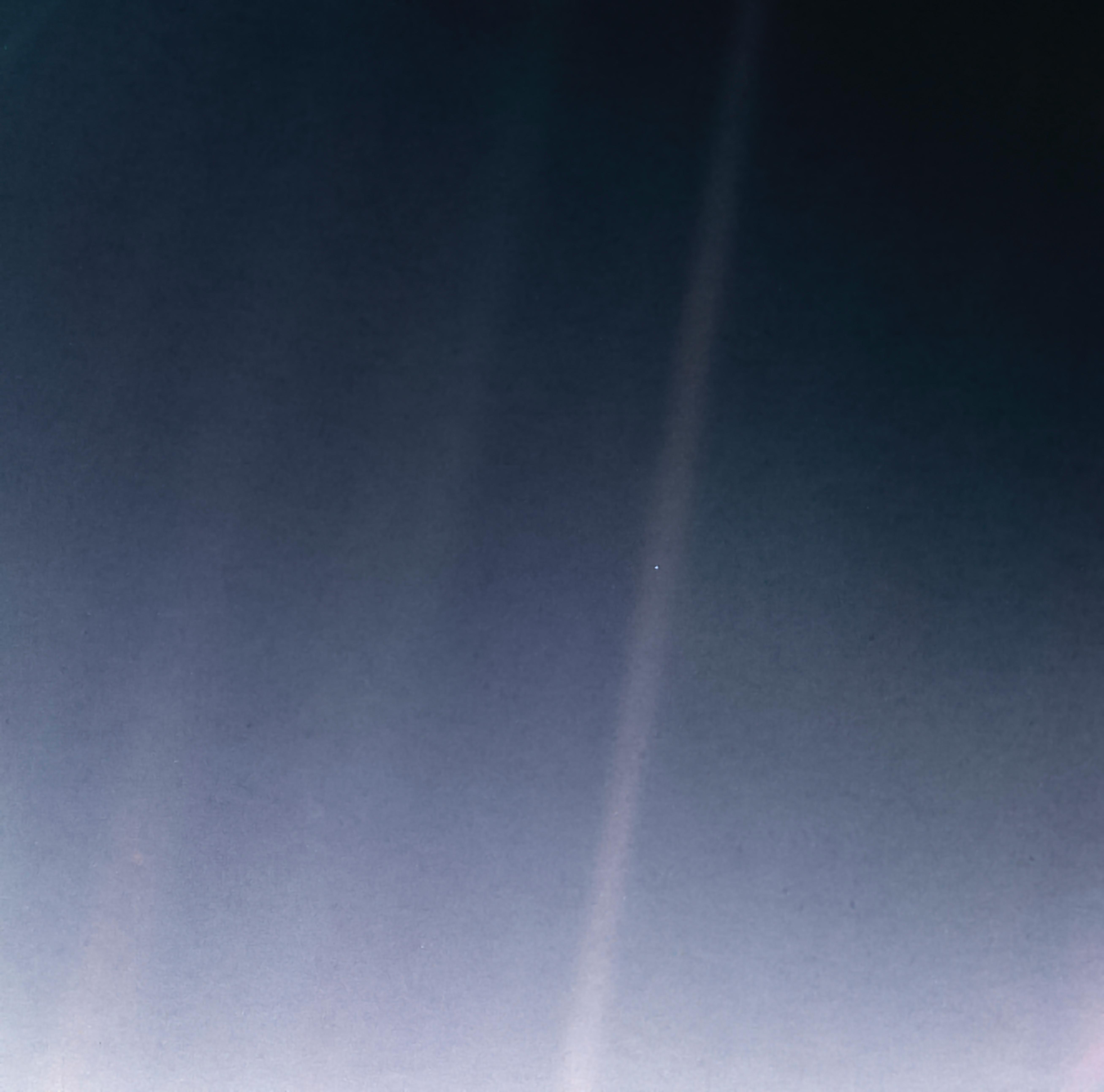
Pale Blue Dot was a famous image taken by Voyager 1 from a distance of 6 billion kilometres, in which Earth appeared as a pale blue dot. This happened on February 14th, 1990, now almost 35 years ago. We learned only this week Voyager 1 has now travelled over 25 billion kilometres, and this at a relative speed of 17 km per second away from us.

From a purely scientific point of view, we didn't absolutely need this picture. We knew perfectly well Earth would appear as a pale blue dot from such a large distance. However, as a scientist concerned about the world, Dr. Carl Sagan decided back in 1990 that it would be worth the trouble to take this shot.

Indeed, the meaning of this image can’t be underestimated. Knowing how something will look like is not the same experience as actually seeing it from such a distance, be it with a remote probe. Humankind took a radical change of perspective there.

Pale Blue Dot sheds feeble light on our extreme isolation and our extreme vulnerability in the universe, something Carl Sagan had extensively explained in his famous television series Cosmos.

I refer to my blog Voyager’s Amazing Tales. 

Picture: By NASA/JPL-Caltech - https://photojournal.jpl.nasa.gov/jpeg/PIA23645.jpg, Public Domain, Link

Tuesday, 26 November 2024

Let so much suffering not be in vain


"Tantus labor non sit cassus" is a sentence in the Dies Irae (Day of Wrath) sequence (form of poem – song). The cheerful subject is the end of man and the end of the world. The man who anxiously awaits his final judgment begs to be saved. The title sentence is a sort of warning, almost a threat: if at least a number of people are not allowed to be saved (including me), then the suffering of Christ will have been in vain. So don't let the first happen (and save me) lest the second happen. One might even recognize in the sentence a certain moral blackmail against God: if He does not save me and my peers, then He will have made the suffering of His own Son meaningless.

We can also apply it to the salvation of our world: "Let so much suffering not be in vain." The Church regularly points out that man is appointed to the management of nature and that he must be accountable for it. If man is letting the world perish by continuing his clear-cutting, then all the sacrifices made by Christ and his followers, including all the sacrifices made by climate activists, will have been in vain.

It can be good to be reminded of this every year. Do I consider the climate activists here to be the modern-day followers of Christ? In a certain way, yes. Of  course, the climate deniers also have their arguments, but in general I do advocate caring and good stewardship with our earth and it is a good time of the year to bring that up again.

I also refer to my blog: "Day of Wrath".

Afbeelding van Peace,love,happiness via Pixabay

Tuesday, 6 February 2024

Temperance Saves the World


Temperance is a virtue which doesn’t have a prominent place in economic textbooks. Yet the word economy refers to thrift and frugality. Economy allows you to be self-reliant and to survive with little means.

Our popular culture and our company culture seems to go the opposite direction, the direction of ‘never enough’, or is it simply greed? It is much easier convincing people to do something than convincing them not to do something. The reason is the imagined group loyalty. Pleading against something may be seen as a rebellious act, a result of laziness or complacency. Pleading in favour of something big is seen as positivity, energy, and good willingness. As a result, companies do too much and have a total lack of focus. Hyperactivity and Beschleunigung have become a plague.

Temperance is exactly what companies need now. Instead of asking what they should do, it may be worth asking what they should no longer do. The question is equally important in times of scarcity of resources. Leadership is also shown through temperance.

I refer to my blog: “Economic Justification in a Culture of Scarcity”.

Picture by Curtis Yancey via Pixabay

Tuesday, 25 July 2023

Fear Of Missing Out – Verpassungsangst


There is no Dutch word yet for FOMO, the Fear Of Missing Out. Germans have the word Verpassungsangst, but the literal Dutch translation 'misangst' doesn’t sound well and could give rise to ambiguities. Anyway, there’s no better time to feel FOMO than vacation time.

Vacation time never brings us what we hope for. We hope to have a chill time, enjoying the magic of places. This is rarely the case. The reason is we think we will be alone at our destination. Everyone we know, seems to go elsewhere. We want to visit another place as an observer; we want to see the place as we imagine it to be and we think we will come back with a unique experience, displayed on unique pictures. Be aware however, if everyone wants to visit this unique place, you will not be alone. You will also belong to the thousands of people who change the image of this place. This is already the case for Venice, Bruges and Barcelona.

It is like in quantum mechanics. If the object is small, the observer influences the observed object. If we don’t want this, we should consider a more ecological way of travelling, the most ecological one being to stay at home and travel in our head by reading books. Immanuel Kant travelled like that.

I refer to my blog Leaving Lazy Tasty Land.

Picture: St Christopher statue and tower of Ulmer dom 2018©Wim Lahaye. St Christopher is the patron saint of the travellers.

Tuesday, 28 February 2023

Onbeschikbaarheid – Unverfügbarkeit – Unavailability

Hartmut Rosa sharply describes tendencies in society that are typical for our time. We know him from his book Beschleunigung about the increasing pace of life in society. In this book Unverfügbarkeit, he explores how contemporary citizens deal with availability and unavailability of things and experiences. He explains how the new categorical imperative sounds like everyone should maximise his reach in the world. He should maximise his possession; he should maximise his impact; he should maximise his fame and maximise his ‘experiences’ in this world. Many things can be explained from other typical features of our time such as the fear of status loss (status anxiety) and the fear of being dumped into the losers’ pit of oblivion due to the power of the Matthew effect.

The author sharply observes the behaviour of city citizens. Like spoilt children they behave ‘blasé’ and cool. They do their utmost to give the impression they can never get impressed by anything. This leads to a kind of numbness and a kind of despair. If everyone performs the impossible to get recognition and nobody is prepared to give anyone else recognition, this leads to a society full of desperate losers. Moreover people tend to seek their happiness in material meaningless differences yet at the same time they can never be happy and remain restless after any material achievement, which happens to be temporary by nature.

Looking for unique experiences, we will always fail if we don't allow the resonant spaces in between the races we run daily. Always looking for news on our smartphone, we succeed in killing every authentic experience. Believing everything should be reachable and feasible, we fail in being grateful for anything achieved. If something goes wrong and proves to be unfeasible, we blame other people, we always find someone guilty and someone to be liable for today’s imperfections of society.

A book worth reading for all people interested in understanding the signs of our times.

I refer to my blogs Disaster and Sin and The Thin Grey Line between the Feasible and the Unfeasible.

Tuesday, 29 November 2022

Newspace


The term Newspace generally refers to this epoch of disruptive change in the space business. Newspace got famous when the space tycoons Elon Musk and Jeff Bezos got involved in a race towards the most advanced rockets. Before that time, the focus of space activities had always been on a handful of large companies and subcontractors who built satellites, ground stations and rockets according to common, relatively strict procedures defined by space agencies. Everybody believed this was necessary for reliable space infrastructure development. Just like in aviation, in space you can't easily carry out a repair if the spacecraft is high in the sky. Even if a crew and passengers are not involved, the costs can be considerable in case of a technical error.

Newspace breaks with rigid structures and methods that are common in the classical (so-called 'upstream') space industry and reduces them to 'terrestrial' structures and methods. The production then usually becomes more, faster, cheaper per piece, and so on. For example, smaller satellites are now being built with less quality assurance, but in larger numbers and with a much lower cost per piece. In case a satellite falls out-of-service, we tend to worry less if there are many left to do the job.

Newspace will also consciously develop technologies cyclically with technology transfers between terrestrial applications and space applications. Aerospace applications usually require high performance (low weight, high strength, great durability, reliability), while terrestrial applications usually require large numbers and low prices. So there is an improvement to be expected in every cycle, in every technology transfer from earth to space and vice versa.

Is Newspace a good move towards sustainability? At first sight not, as it threatens to launch too much objects into space, increasing the problem of space debris. On the other hand, thanks to Newspace, we now have reusable rockets. But the largest leap towards sustainability is to be expected from the developments in life sciences for long duration manned space missions. Water and waste reuse, small scale agriculture and other essential biological functions will find sustainable implementations in space and on the Earth.

I refer to my blogs space trends in 2022 and sustainability engineering. 

Picture from shutterstock.com 

Tuesday, 22 November 2022

Concorde


On 22 November 1977, today 45 years ago, the first Concorde flights between Paris, London and New York were scheduled. I was 12 years old at that time and was the proud owner of a Concorde plastic scale model.

Even today, a project like Concorde would seem extremely ambitious. On top of the technical challenge, it was also a challenge in international cooperation. It suffered many delays and costed more than ten times the initially estimated cost. It had a lot of safety issues and finally had to be stopped. Surely, Concorde was not a sustainable aircraft.

Why should I spend time on this lost cause? It has to do with human nature and the human condition. Humankind needs to be ambitious. We need to know what our limits are. If you want to know your limits, you can only do so by exceeding them. This is what we have done with Concorde.

Aviation and space are the technical areas where we can push the technical limits most. They are the playgrounds of many dreamers who do. We will do much more useless endeavours. In the long run, however, they are not useless because we are learning. We are not only learning in the technical sense, but we are also learning on the level of international collaboration. Concorde shows what is possible. The same can be said about the International Space Station.

I also refer to my blog: “Gute Technik ist immer schön“ and “ode to aviation”.

Picture: taken 2018 by ©Wim Lahaye in Udvar-Hazy Center Chantilly, VA, USA

Tuesday, 11 October 2022

Work

James Suzman’s book title sounds to us like an order. This is exactly the subject of this book. How did we get to today’s attitude towards ‘work’, including our work ethic?

The author starts with nature. Work dissipates energy and increases entropy in accordance with the laws of nature. Strange things happen: male masked weavers (birds) make and break their nests endlessly for no other apparent reason than to show off for the female masked weavers. The energy they dissipate in doing this is in no relation to the functional outcome of their work.

The author then considers work in an anthropological view. Our ancestor hunter gatherers only ‘worked’ for meeting their instant needs. It is through the agricultural revolution that man started working for meeting his future needs and it is at that point that slavery originated. The author then describes the evolution of ‘work’ and its meaning in the industrial revolution with the intellectual contributions of people like Thomas Robert Malthus, Benjamin Franklin, John ‘Saint’ Lubbock, John Maynard Keynes and John Kenneth Galbraith.

The author points to a few aberrations in society’s attitude towards work. The agricultural and industrial revolutions have brought us to a certain work ethos and a corresponding belief in merit as the right measure for work reward. Yet the highest earners are not the hardest workers but the largest owners of assets, being thereby the largest receivers of dividends and bonusses. It is not the labour effort that pays off, but the market value of the ‘work’ one seems to offer to society. Other related aberrations are the silly ‘war for talent’ and the cases of karoshi in Japan.

The author also points to Parkinson’s law according to which work inevitably expands to fill the time available for its completion. Bureaucracies will always generate enough internal work to justify their existence. Many people don’t have meaningful work anymore but fill their time with the rope of their house mortgage around their neck. The author concludes that many of our core assumptions about economy and work are an artifact of our past and we could free us from them to imagine and create a better future.

I refer to my blogs: Ode to Industry, Full Time could be Less and Revolution is in the Air.

Tuesday, 16 August 2022

21 Lessons for the 21st Century

A successive story of the future after Homo Deus. Yuval Noah Harari describes the challenges we face in the twenty first century when biotechnology and artificial intelligence will change the world we live in. Workers may not only become redundant; they may become irrelevant for the socio-economic system, much like horses became irrelevant in the economy at the beginning of the 20th century. A tiny meritocratic elite could push everyone else into irrelevance and oblivion. The problem is exactly that our merit is only based on work and money.

Another phenomenon is the globalisation. It looks like people are still in need of some stronghold related to their identity. Is it worth re-empowering the nation state? Or should we reconsider our ancient religious traditions? Or is it too late for all that? One of the strongest points of this book is the accurate analysis of the political issues in Europe like the immigration issues and the tensions between the member states.

If machines can produce all we need, couldn’t we all benefit? Could we consider UBI – Universal Basic Income, the taboo subject of all rich conservatives? Taking care of people, be it children, elderly or disabled people, should indeed be considered a job and should be rewarded in some way.

Yuval Noah Harari also points to ethical dilemma’s related to new technologies like self-driving cars. What if you can configure the decision mechanisms when the car faces a dilemma between protecting the driver and protecting other road users?

Religions should take humility more seriously. They should stick to their commandment not to use the name of God in vain. That would already block abuse of religions for worldly affairs like war.

It is extremely hard to discover the truth when you are ruling the world. Yuval Noah Harari doesn’t believe in a real autonomous authentic self. We are all subject to manipulation from our environment. Our brain is trained to be programmed by what happens around us. Becoming aware of this, is a first step to wisdom.

As we are good story-telling creatures, can we come up with a good story that holds us together and gives us an identity? It should be a story that gives everyone a role to play and extends beyond our horizon. It should be bigger than ourselves. Perhaps space travel, inspired by ancient myths could be considered, but the story is yet to be written.

The University of Leuven organises Lectures of the 21st century since several years now and the summaries are often inspiring for my blogs. I also refer to the Why of Technology.

Tuesday, 16 November 2021

Day of Wrath


Humanity will eventually come to an end. This is scientifically sure, as far as things can be scientifically sure. I remember the day I learned this as a child in primary school. My parents and my teacher tried to reassure me: I myself would (probably) never experience it. They didn't understand that wasn't sufficiently comforting to me; I could empathize perfectly with the people who will actually experience it and I still can today. The nightmare of being lifted up and swallowed down into the earth is as realistic as it could be. Many people didn't survive this experience this year.

It all became more understandable as I learned about the cosmos and humanity. The second law of thermodynamics tell us nature will gradually eliminate all useful energy differences and turn our universe into a lukewarm lump of iron. Furthermore, our earth and our sun have a finite lifespan. Possibly we can still try to escape to another place, but the question is whether we will learn that in time. Humanity (or a new super-human successor) can perish from natural cataclysms such as meteor strikes, comet impacts, solar expansions, volcanic eruptions, uncontrollable biological plagues, such as epidemics or new extremely successful life forms. We discovered we can also create the cataclysm ourselves: continuing burning fossil fuel is probably the fastest way. We are extremely vulnerable.

Therefore, good management and responsibility are more important than ever. Glasgow 2021 can become either a milestone of salvation or a milestone of auto-destruction. Management and accountability are also a common thread in Christianity. In the Bible, man is often appointed as a steward of precious things (the parable of the talents, the prodigal son, the appointment of Peter). On the return of his master, the steward is held accountable for what he has received. The intuitive religious feeling that we will be reckoned off for what we have done with our planet is seamlessly aligned with today's scientific findings. Care for the Earth is needed more than ever.

I like to refer to my previous blogs: "Sustainability Engineering", "Heat", "Durban" and "Biosphere 2".

Photo: European Space Agency (Rosetta mission) – license text can be found at http://creativecommons.org/licenses/by-sa/3.0/igo/

Tuesday, 19 October 2021

The Trap of Technology

In May this year, I wrote  about what drives us to technology. I refer to my blog The Why of Technology. In this blog I share a few thoughts about the opposite: why we should NOT be driven to technology and why technology can be a trap.

Technology is supposed to make us happy but tends to make us unhappy by being too demanding and changing our habitat too rapidly. We don’t fully master technology and the pace of technology. Technology also imposes itself too much in our free time.

Technology may generally be beneficial in the long term; it can however be disturbing in the short term because we continuously adopt half-baked products. As early adopters, we become part of the product development process without knowing. This leads to a lot of frustration. Will we still have Windows updates in 2030?

The idea that all new products should be within reach of everyone is a dangerous idea. Was it really a good idea to bring the car in reach of everyone? We can no longer imagine otherwise. Travelling should however be a privilege. Perhaps some developments should mature longer within a smaller group before they are released for mass production. We should not all become space travellers. Leave the privilege to people who deserve this, like captain James T. Kirk.

Other interesting questions have been asked within Homo Deus : who wants to live forever? Who is afraid of Artificial Intelligence?

The purpose of technology lies outside of technology. The human sciences should help us engineers find out what should have the priority. Collaboration with human scientists is important for engineers because we need to make choices. Technology should be there for the sake of humankind. Humankind is not there for the sake of technology.

Tuesday, 27 July 2021

Disaster and Sin


Disaster is an inevitable consequence of the vulnerability of life. Most natural disasters are caused by coincidence: bad weather, volcanic activity, lightning. Due to our anthropo-centric thinking however, we all have the tendency to associate natural disaster with human failure. Noah’s Flood needed to wash away the sin of mankind. In the Middle Ages, epidemic plagues were caused by people collaborating with the forces of Evil. You would think that in our scientific paradigm, we could classify our recent flood disaster as a meteorological coincidence and not as a result of human sin? No, we still like blaming our fellow human beings. "The politicians didn’t see this coming." "Neither did the scientists." "China is pumping too much carbon dioxide in the sky" (but we still buy their products). This happens in a society which believes it has everything under control.

The same happens in organisations. When an ICT incident happens in a company, it is not the hacker who is blamed, it is the company internal ICT security officer. Don’t forget we live in a meritocracy and in the delusion of immanent justice. If something bad happens, someone must have done something wrong. This delusion makes us associate the most 'natural' (in this case externally caused) disasters with the bad behaviour of our fellow human beings. 

Nobody seems to argue that this bad weather was simply not foreseeable and that our hydrological infrastructure is not ready for such quantities of water. Measures were taken, but not sufficiently. That doesn’t mean it is someone’s individual fault. Even collectively, we can’t really predict what the infrastructure priorities should be. Only our hubris assures us we can anticipate all catastrophes and work out the perfect policy against them. I don't suggest we shouldn't worry about the climate, on the contrary: the principle of precaution should always prevail. But we should not amalgamate bad weather and climate change.

I refer to my earlier blogs “Stop the Blame Game” and "Don't Watch the News".

Tuesday, 8 June 2021

Clearcutting the Earth


Multinationals bring great wealth to society. In and around multinationals, the most amazing discoveries and inventions are made. We have to recognise that. It started with the wealthy shipping “companies” in the seventeenth century and continues today with the big data companies such as Apple, Google and Facebook. We should be grateful for the material progress multinationals have brought us. 

Many multinationals have started using ESG (Environmental, Social en Governance) criteria in deciding what to do and what to don’t do. They realise their reputation as well as the Earth’s sustainability is at stake. What they don’t seem to realise well, is their impact on the ‘small ones’, the small suppliers, customers, labourers, etc.. In the animal world, big eats little and the same happens in industry. The small or poor ones can never properly negotiate with the big one. The big one determines the conditions, just like the elephant decides where he treads. The ants have to make sure they get away in time. The negotiation process between big and little is never really a negotiation process; it always ends with little accepting the conditions imposed by big. Multinationals have to become more aware of their tremendous leveraging power in negotiations and their huge impact on local industrial and agricultural ecosystems. This awareness could have saved us from our most bitter memories of colonialism. Alas, colonialism is still going on, in a different way than before. It leads us to a progressing geographical Matthew effect.

Negotiation should be done between equals, not between elephants and ants. Inequality induced by unfair negotiation is however not the privilege of multinationals! It would also be good if multinational shareholders started paying taxes, like we all do. All-mightiness is usually a bad thing.

See my blog on Globalisation, as well as my Dutch blog: De Kaalslag and Kwellende Rijkdom.

Picture from shutterstock.com

Tuesday, 11 May 2021

The Why of Technology


The Why of Technology has always seemed obvious. Technology was perceived to fulfil a shortage. It fulfilled a need that had been unfulfilled all too long.

This is changing. On the one hand, the basic needs are being fulfilled and the new needs are becoming ever more subtle. On the other hand, the complexity and the cost of new technologies are getting out of control. A focused orientation is needed. It becomes essential to choose well where scarce resources should be allocated to. The corona crisis forces us to stay at home and think. It encourages us to think what society could really need next in terms of technology.

The why of technology can be written as an ABC: Achievement – Beauty – Commodities. Commodities are obvious, since Homo Habilis started creating his own tools and weapons millions of years ago. Commodities are the fruit of our creativity and our industria (activity). They are still important. We need trains, we need water, electricity and Internet. We need smartphones and social media. Beauty may not be the first word we associate with technology, but for the engineer or designer, it is an important driver. Achievement is a very powerful driver. In the Middle Ages, it made superpowers invest in cathedrals. In the 16th century superpowers rivalled with maps. And in the 21st century, superpowers invest their money in satellite constellations. The eagerness for achievement made America go to the moon. It will make mankind go to Mars very soon. Technology also needs to fight its own drawbacks. We need a circular economy to keep the world sustainable. We need technology to get rid of carbon dioxide emission, to resolve the traffic tangle, to protect our data, etc.

As the possibilities of technology are endless, we really need to ask ourselves the question in what direction we want to go. What do we want to do with Artificial Intelligence, with gene manipulation, with new materials, with hydrogen fusion? How much progress could we make when we understand better how the brain works? Should we try to extend our habitat to space? These questions are not easy to answer. The mere fact that something is possible, doesn’t justify its development. The question is both collective and individual. It is both material and spiritual. To what kind of existence are we called? What is an ideal way of living? It is a scary question in postmodern times. What is our mission and what might be our destiny? We could come up with individual answers that differ very much. Can we also come up with a collective answer?

I also refer to “Homo Deus” and to "A Sea of Change".

Tuesday, 9 March 2021

Be resourceful and courageous


In this season, we easily feel angry and passionate about things. We are deeply frustrated about the problems of our time, the small Corona crisis and the big Environment crisis. We show our wit in the media by pointing to the political causes of the problem. In the end however, our sharp view gets lost in an ocean of views. It needs to hide our helplessness and despair in solving the planet’s problems.

In this Sunday’s lectures, Christ assembles his own self-made whip and chases all merchants out of the temple, fulfilling the prophecy: “The passion for God’s house will consume me”(*). Christ’s anger was a sign he cared and so is our anger a sign we care. His anger made him violate the local rules. The rules did not serve their purpose anymore.

When we obediently follow the rules, we may be safe at home and safe for criticism, but a lot of people will miss our compassion and companionship. We may feel very sorry for ourselves, but the Corona crisis hits the poor and the lonely most, those who live in narrow spaces, alone or with the elderly and the sick. They are the victims of the Matthew effect of Misery. Our blind obedience to the rules, without compassion, does not serve any purpose. How can we violate the rules in a smart way? When the impossible needs to be done, we need to look for virtues of people who are used to do the impossible: boy or girl scouts, engineers and entrepreneurs. Resourcefulness and courage are needed most in these impossible times. They are the basis of our resilience.

The word resourceful doesn’t exist in Dutch. We say ‘finding-rich’ (vindingrijk) but this word actually means inventive. The meaning is close however. Resourcefulness is the ability to recognise hidden resources and combine them in a smart and courageous way to achieve the impossible. In the overdose of news we get, I sometimes discover wonderful stories of resourcefulness and courage. The question is whether you can cultivate these abilities or whether you need to be born with them. It is a bit of both. Resourcefulness and courage are powerful blends of virtues and talents (so-called ‘gifts of God’).

(*) Footnote: there is a growing tendency in the catholic church to interpret God’s house as our planet Earth. The lecture can therefore also be understood as a teaching not to mess with the planet.

Inspiration from an article by J. Haers, Kerk & Leven 2021/09.

Picture: Water mill at Arenberg Castle, Leuven ©Wim Lahaye


Tuesday, 28 July 2020

Locus Iste

"Locus iste" is a beautiful choir song written by Anton Bruckner in the 19th century. The full first sentence is: "Locus iste a Deo factus est", which simply means: "This place is made by God".

The song indicates the sacred character of the place we are allowed to live in, whether that is our own house, our local house of worship, our village, our town, our country or simply the beautiful landscape we live in. Whether one is a religious person or not, everybody can stand in awe sometimes for the beauty that surrounds him.

It may remind us of the fact that we don't need to go far to discover wonderful things. Before we book a trip to the other end of the world, we may envisage a place nearby we never even took the time to visit earlier. At the age of 55, I'm still discovering nice places I've never been before less than an hour away from home. The concern about the environment is already a  good reason to do that, but in this peculiar year 2020, the Corona crisis offers an extra reason to enjoy more vacation locally.

I refer to my earlier blog: "The Magic of Places".


Tuesday, 26 May 2020

Not back to normal, please


Never waste a good crisis. The corona crisis is a huge opportunity to change a number of things. Therefore, let us not get back to normal! Last month, 170 Dutch scientists signed a manifesto for more sustainability and social justice. The core of their manifesto consisted of five demands:
  1. Replacement of the current economic development model, focused on generic growth of the BNP, by a new model, which distinguishes sectors that need investment (energy, education, healthcare) and sectors that should shrink because of their lack of sustainability (oil, gas, mining) or their role in the encouragement of overconsumption (publicity).
  2. Development of an economic policy that aims at redistribution, one that foresees a basic income for all, progressive taxation, reduction of labour time and sharing of jobs. More recognition for jobs in health care and education.
  3. Transition to a circular economy, based on biological diversity, more sustainable, local food production. Reduction of meat production. Employment with social justice.
  4. Reduction of consumption and travelling, transition from luxurious wasteful travelling to more sustainable, essential and meaningful types of travelling.
  5. Reduction of the debt for those who have been hit hardest: employees, small entrepreneurs and countries in development.
A lot of these points have been mentioned before in my blogs about sustainability and economy. Let us not waste this crisis.

Tuesday, 11 February 2020

What Satellites Can Do for You

Satellite applications and services make up the essence of my work life. As I regularly talk about satellites and their applications in daily life for interested groups of people, I thought it would be a good idea to summarise all this in a short article. It is useful for laymen to understand how important and diverse the applications are. And it is useful for people in the satellite world to have a concise summary that helps them to overthink the multiple possibilities. Some of the topics have already appeared in this blog, usually under the label work. As this article is however close to my work life and my CV, I decided to publish it as an article on LinkedIn.