Showing posts with label management. Show all posts

Tuesday, 20 January 2026

The Hubble-Lemaître Effect at Work


On this Blue Tuesday, we may observe an awkward phenomenon at work. No matter how much we love our colleagues, our colleagues seem to drift away from us. If we consider our cubicle as an island and our manageable individual work as the perimeter of that island, we notice ‘our’ island doesn’t touch our colleagues’ islands. Due to the incredible employment costs, efficiency is essential and we will surely not have overlapping land to manage. On the contrary, there is a lot of sea between us, to be interpreted as a lot of work that is not covered by any colleague. Moreover, due to the multiplication of work, our islands seem to be drifting apart, with a risk of alienation from our colleagues.

Astronomers will recognise this. The resemblance with the Hubble-Lemaître effect is striking. The Hubble-Lemaître effect describes the observation that the celestial bodies around us show a red Doppler shift proportional to their distance from us. The conclusion was that all celestial bodies are therefore moving away from each other and the universe must be expanding. Replace ‘celestial bodies’ by ‘colleagues’ and ‘distance’ by amount of work lying between you and your colleague, and you get the point. No matter how hard we work, the amount of work ‘not done’ is always getting larger and we are not getting closer to our colleagues, on the contrary. There is always more work coming in. No matter how many colleagues we can recruit to fill the gaps, work between us multiplies faster than we can execute it. We see our dear colleagues drifting away from us and they may observe the same phenomenon.

The redshift observed may be an analogy to the red cheeks we show by leaving so much work undone. If our colleagues are a bit shameless and pay only attention to our personal shortcomings, our relationships may deteriorate and we may even become disconnected workers.

The solution to the Hubble-Lemaître effect at work is halting the multiplication of work. Throw at least 50% of new actions into the oblivion pit! Looking back in the past, you will notice a lot of actions never led to any progress. I agree we don’t always know this in advance. We could have guessed, however. We should create new actions with a sense of responsibility. Actions which simplify should be preferred over actions which make life more complex. In the long term, there is more work disappearing through sound oblivion than through proper execution.

Last year on Blue Tuesday, we discussed the Yerkes - Dodson Law.

Image by Rizve Joarder from Pixabay 

Tuesday, 21 January 2025

The Yerkes - Dodson Law

On this Blue Tuesday, we may want to have a look at yet another work performance theory, namely the Yerkes-Dodson law. In its most classical representation, it shows work performance on the Y-axis versus arousal (stress level) on the X-axis. The curve typically has an ‘inverted u’-shape or bell shape. For complex tasks, the stress level tipping point (maximum) typically occurs at lower levels of stress than for simple tasks.

The scope of validity of the Yerkes-Dodson law may be a point of discussion among experts, but we all feel it corresponds to our own experience. We need a little bit of stress to come to good performance – we call this ‘flow’. However, when stress gets too high, we tend to get anxious, superficial, confused and we lose our concentration.

In a certain way this law pleads against additional pressure and against multitasking. Multitasking may be required when individuals need to achieve a certain productivity for the money they are paid. Productivity has become a major concern in labour market policies. Nowadays, you couldn't afford giving an employee a single task, although it could be better for his stress level.  Multitasking increases the complexity of work and increases our stress level. We will inevitably end up on the lower right-hand sides of the curves and show relatively poor work performance. Stress and all related inefficiencies seem to be unavoidable in this valley of tears. It may make sense to spare our colleagues and ourselves from more.

Let us further reflect on the Yerkes-Dodson Law at work and at school.

I refer to my blog: The Disconnected Worker.

Picture: Afbeelding van Enrique Meseguer via Pixabay

Tuesday, 29 October 2024

The Art of Delegating


The work around us tends to multiply. Even and especially at peak performance in our work, we need to think timely of new employees and potential successors. If we don't train them in time we may get lost on our lonely island of work and be forgotten by mankind after our death. Workplaces don’t carve the names of the deceased in stone, not even in sand. Without successors it is not only us who will be forgotten but even the fruit of our work will disappear for good.

Breeding new successors requires trust. A successor can only continue your work if you took the time to make him/her familiar with your work. You also need to allow him/her to make a contribution to your work so that your work also becomes his/her work. Your successor also needs to trust you otherwise he/she will not take care of the continuity of your work. A successor doesn’t only need your knowledge, your skill or your craftsmanship. He/she also needs your motivation and your fire.

Therefore, let us slow down our current work a little and talk to potential successors. In the long run our work will not have slowed down and it will be our successors who will bring our work to completion and fulfilment.

Picture: Thorbeke Monument in the Hague via Pixabay.

Tuesday, 6 August 2024

Seek for Advice


Life has always been complicated. Sooner or later in their lives, all people ran into situations where they needed some kind of advice. In the old days, you could get this advice from shamans, priests, counsellors, teachers, witches or just from good friends, which was probably the best. The ancient Greeks, if they were wealthy enough, could travel to the oracle of Delphi to get some advice on what to do next.

In our society, seeking for advice looks easy but may not be that easy. A first impediment for seeking advice is our obsession with autonomy and self-reliance. Everybody is very busy appearing autonomous. Asking for advice requires a certain humility. You may need to recognise someone else for his/her specific competence. Even worse, you may discover you got it all wrong to start with. Any kind of advice, whether free or paid, may require a certain gratitude from you. Gratitude is sometimes difficult to convey.

A second impediment for seeking advice maybe the fact that we feel bombarded by advice already. In the good old days, we needed to ask for scarce information; nowadays information is abundant and thrown at us at megabytes per second. As a result, we develop a defensive attitude towards advice. We remain just as helpless as before as we now need to filter out the rare useful information from the information ocean. Therefore, we still need personal advice, more than ever.

Let us think this week on what topics we may need advice. You can't honour your fellow human being more than by asking advice. Saint Paul's advice would be “to put on the new man” or as we say in Dutch “Enrobe yourself with the new man (person)”. (‘Bekleedt u met de nieuwe mens’). Be a brand-new person. Good advice may lead us to a good life and to reinforced friendship.

I refer to my blog Dare to Expect.

Picture: Delphi, Greece, picture taken in 1991 ©Wim Lahaye

Tuesday, 14 November 2023

Leadership and Subjectivity


When Moses arrived on the top of Mount Nebo in Jordan, how did he know this was the land he had announced to his people, the Promised Land? The objective truth is: he didn’t know. Perhaps the view is magnificent as we can see on the picture, but there were other people and other armies down there. It is reasonable to assume Moses got tired roaming through the desert for forty years. Otherwise, there was no objective fact indicating this was the end destination for his people.

The book of Exodus, which tells the story of Israel’s people leaving Egypt under Moses and his brother Aaron’s leadership, is a splendid manual on leadership. Don’t get me wrong, I don’t read the scriptures because they are useful. I read them because I love them. I love them because they are beautiful and because I feel like they could make me a better person. But for those of you who don’t love the scriptures, beware the book of Exodus contains all you need to know about leadership.

The Bible says Moses knew from God. But how does God speak to man? It never happens through objective reasoning. Moses didn’t have any useful objective data that would have allowed him to make a reasonably good decision. Moses knew almost nothing about the land in front of him and the strength of its armies. He needed to rely on his inner voice, through intuition, prayer, belly feeling, dreaming, sense of responsibility and love for his people, in short through his own subjectivity.

If good leadership in difficult circumstances requires subjectivity, it has a serious implication for the leader. The people need to believe him. They need to give him the authority to rely on his personal subjective feelings. They will only do this if they believe he is good, wise and integer. And this belief is usually based on some common experience in extremely bad conditions, such as the experience in the Sinai desert. If the people’s belief gets lost through some negative experience, the leader becomes extremely vulnerable. The leadership crisis we observe today, is due to a lack of common experience in the desert and a lack of willingness to grant authority to someone else, usually because of our own narcissism. The conclusion of this blog is that in leadership, subjectivity is objectively required.

I also refer to my Dutch blogs Leadership and Love and Dreamers Who Do.

Picture: Mount Nebo, Jordan, 2023 Courtesy of Patricia Deneffe

Tuesday, 18 January 2022

The Disconnected Worker


On this Blue Tuesday, somewhere between the fourth and the fifth Corona-wave, we make some awkward observations. First, we have never been told so often that it is important to be happy at work. (A boss of mine told us in the nineties that we were not at work to be happy; there is some truth in that but the fact that his employees still remember his statement today, is clear enough.) In their search for rare talent, employers do their utmost to show concern for the well-being of their employees. Secondly, a lot of employees do not want to return to their workplace, not because of the infection risk, but because they don’t feel well anymore in their workplace (especially in the so-called 'cubicles' or in landscape offices). A lot of them got tired fighting in solitude against unachievable expectations.

Tomorrow 19 January (2000-)2022, we remember Frederick Herzberg, who described the two-factor theory or Motivator-Hygiene Theory. Basic idea is that job satisfaction comes with intrinsic motivators like challenging work, achievement, recognition, responsibility, autonomy and meaning. Job dissatisfaction is not the opposite of job satisfaction and comes with extrinsic hygiene factors like salary, status, job security, benefits, work conditions.

In a lot of cases, employees get discouraged because their opinion is never really asked. A computer questionnaire is not a good way to collect opinions. The ambient noise level in computerised companies is so high that only the loudest voices are being heard. This is most discouraging. Simon Sinek insists that good leaders are good listeners and that employees can only achieve the (‘Herzberg’) job satisfaction by looking for their ‘why’. Hilde Helsen developed her own method to assist Dreamers who Do in achieving this.

Happiness at work cannot be an employer’s responsibility only. Employees also need to get rid of meritocratic compulsive thoughts. One typical compulsive thought sounds like this: if employee A is the manager of employee B, then A must be happy and B must be unhappy. A must be the best and B must have done something wrong in the past; B can only blame himself. You may notice this reasoning is ludicrous, but suppose you end up in situation B? Jealousy (in German there is a more subtle nuance between Eifersucht and Neid) is a bad idea. How ridiculously this may sound, it dominates the way we think in a meritocratic society. The way we think is a perfect recipe to be unhappy at work.

I refer to my blogs: “The Why of Technology” and “Intrinsic and Extrinsic Motivation”.

Picture: shutterstock.com

Tuesday, 26 October 2021

D & I versus Competition


Large companies spend an increasing amount of time on Diversity and Inclusion initiatives. This is good in itself, and it doesn't need to be justified by the fact that D&I supporting companies are worldwide more successful than others. The reasoning can be also inverted: successful companies tend to operate in diverse places, recruit a diverse workforce and can afford investing time and energy in D&I.

Recent evolution in the topic is the question whether people really feel included in the workplace. It somehow reminds us of Hans Christian Andersen's tale of the ugly duckling: everyone can experience that awkward feeling: "Do I belong here?" and "Where do I belong?". Initiatives like www.understood.org plead for more understanding for parents and children struggling with hidden impediments. Generally, people should feel safe disclosing disabilities that aren't visible, even in the workplace.

I am very much in favour of this and I believe in the benefits for industry. However, D&I will not work if we continue believing in meritocracy and individual competition. Salary and recognition, including 'right to stay' in bad times, are still too dependent on individual, often subjective, evaluation. If we believe in diversity, we should also believe in diverse, non-quantifiable, contributions. Competition should be between companies, not inside companies. Individual performance will become meaningless over time and subordinate to team performance. In a D&I culture, individual attitude should be recognised and rewarded however.

Generally, a culture of numbers will harvest numbers, and the workforce will become unhappy over time. A culture of collaboration and inclusion will harvest good numbers and beauty, and the workforce will be proud and happy.

Tuesday, 3 April 2018

The Effective Executive - Peter Drucker


The Effective Executive is perhaps the world’s most renowned management book and you will find plenty of references on the Internet. In this blog, I only wanted to share my favourite quotes:
  • Establishing priorities, and concentrating your efforts on them, is a skill that requires foresight and courage.
  •  There is one exception to the rule of building on strengths and covering weaknesses. Character and integrity do not accomplish anything by themselves. But their absence faults everything else. Here, therefore, is the one area where weakness is a disqualification by itself rather than a limitation on performance capacity and strength.

I refer to my earlier blog: “Seven Golden Rules of Management” and “The Knowledge-Creating Company”.

Tuesday, 13 March 2018

In Search of Praise


March is Compliment Month, therefore we could elaborate a little theory on compliments before moving over to well-founded practice. After all, we had made a New Year’s resolution that we would work on our mildness. Lent is a good time to implement change in our life.

In a time where expectations tend to be sky-high, we may get a little depressed from the difference between these expectations and our realisations. It may become difficult to maintain a positive image of ourselves and we may start longing for a little compliment for the hard work we have been doing. But praise is a scarce good and our work environment sometimes resembles a desert where the dwellers are all desperately looking for a little drop of recognition. A compliment is therefore very powerful and if you give someone a compliment, that someone may be eternally grateful. And compliments can be given for free, so why is it so difficult to give compliments?

One answer is that it is difficult to mean compliments. It is difficult to sound honest because it is difficult to be honest. In a time like ours, where our self-esteem is at stake, we may be too busy with our own image and we may expect too much from others, therefore tend to focus on their weaknesses. Giving compliments requires modesty and modesty paradoxically, requires a positive self-image.

Giving compliments is good for your own recognition. You don’t expect reciprocity though, and you shouldn’t. You will somehow always share in the joy of your praise. The receiver has all interest in returning some esteem to you. After all, the value of your compliment does not only depend on its content, but also on your credibility as a giver, therefore the receiver has a clear interest in supporting your credibility. Other people may not always agree with the compliment you give and they might even become jealous, but at least they realise that you sometimes praise someone. And someday, they may also enjoy such a rare moment of praise. They may even want to become your friend.

I also refer to my blog: “The Importance of Being Gentle”.

Tuesday, 17 January 2017

Future Shock

Who remembers this book? Future Shock by Alvin Toffler was published in 1970 and became a world-wide bestseller. My father's copy dates from August 1981 and I read it a few years later, around the time I finished secondary school.

The pocket edition counts 490 pages. The English is well-written. The table of contents is nice to read: it counts many well-chosen subtitles, like "Flamenco in Sweden", "The Paper Wedding Gown" and "The Mournful Movers".

The book is not a utopian description of how the future should be, but  rather a futurist description of how it will be. The title Future Shock refers to an illness: "Just as the body cracks under the strain of environmental overstimulation, the 'mind' and its decision processes behave erratically when overloaded. By indiscriminately racing the engines of change, we may be undermining not merely the health of those least able to adapt, but their very ability to act rationally on their own behalf".

Alvin Toffler's vision on economists is still very relevant today: "The year 2000 is closer to us (in 1970!) than the Great Depression, yet the world's economists, traumatised by that historic disaster, remain frozen in the attitudes of the past....If it were possible to pry from their brains their collective image of the economy of, say, the year 2025, it would look very much like that of 1970-only more so."

Many family tendencies like gay marriage are already anticipated in this book. Toffler also writes: "Men and women today are often torn in a conflict between a commitment to career and a commitment to children."

Concerning politics, Toffler writes: "We are rushing toward a fateful breakdown of the entire system of political representation. If legislatures are to survive at all, they will need new links with their constituencies, new ties with tomorrow."

The odd thing is that this book doesn't mention mobile phones and internet. In those days, the fax was the emerging communication technology! Nevertheless, Alvin Toffler imagines a machine called OLIVER, read the extract below and compare with our Internet.


We can conclude that most of today's general tendencies were already emerging long ago, longer ago than we tend to believe today. On the other hand, the specific technical developments and especially the order in which they spread over the world, seemed much harder to predict.

Tuesday, 10 January 2017

The Virtue of Patience and the 10000 Hour Rule


Patience is an underrated virtue. In our age, everything seems to be within reach. As a consequence, we live in a time of hyperactivity and continuous tantalising. And yet, as Maria Popova points out in her marvellous blog 10Learnings from 10 Years of Brain Pickings, “Expect anything worthwhile to take a long time.” What could be really worthwhile? I would consider education, acquiring knowledge and skills, but also: good human relationships and peace.

Concerning education and the acquisition of knowledge and skills, many students and young graduates suffer from a lack of patience rather than a lack of talent. Malcolm Gladwell mentions in his book  Outliers the 10,000 hour rule: you need to collect around 10,000 hours of practice if you really want to be good at something. The rule is certainly valid for hardware and software developers, but also for practitioners of the higher arts like musicians and painters.

There are two serious issues with patience. The first one is that not all stakeholders may show the same patience for the same purpose. As a result, your project can be cancelled, not because you didn’t have enough patience, but rather because someone else didn’t have enough patience (e.g. your teacher or your manager). This is also the case in peace negotiations: if one party doesn’t have enough patience, the peace process stops and war restarts. War is always a consequence of a lack of patience.

A second serious issue with patience is that you can’t really possess it. It is not a permanent character trait or virtue. You don’t have patience, you practice it in given circumstances for a given purpose. One moment of weakness, a moment of impatience, can jeopardise an entire project or venture. One can also be very patient in reaching one goal and very impatient in reaching another goal.  

The good news about patience is that it can bring us to things of real value. To reach a such a ‘higher’ goal, we will always need dedicated time and we will need to overcome anxieties. To overcome the time, we need patience; to overcome the anxieties, we need courage. Patience and courage go well together in any achievement we aim for. And in essence, our admiration for people is essentially based on virtues like patience and courage, not on achievements. The actual achievements will be surpassed by newcomers, but the virtues will remain. 

I refer to my earlier blogs: "Ode to Industry","Virtues and Virtutes" and "You are your time"

Saturday, 5 November 2016

Intrinsic and Extrinsic Motivation


I got fascinated recently by the many causes of perception differences between people. One of the most misunderstood “properties” of people is their motivation. This is important. Motivation is considered to be a key economy driver, certainly in a knowledge society, where the internal motivation, the drive, the passion are needed to make progress. Recruiters do not only assess a candidate’s knowledge and experience, but also his/her motivation to do the job. And motivation is also understood as an important factor of well-being and happiness at work, therefore essential to keep the employee in a positive, constructive mode.

Yet the Harvard Business Review published in 2003 an interesting article  entitled "Why we misread motives". We are very bad at  assessing what drives somebody else. We all know our own intrinsic drivers: creativity, pride about our work results,  recognition, new challenges, … Yet when it comes to understanding the drivers of other people, we believe they are driven by salary prospects, yearly evaluations, work result control, etc. We claim we are driven by intrinsic motivation whereas others need extrinsic motivation to get going. The study casts justified doubt on the usefulness of evaluation conversations and points out that the way we run our businesses today, with a lot of control, leaves a lot of potential unused. Control needs effort from both the controller and the one who is being controlled. Moreover, the article suggests the controlled one may even lose his intrinsic drivers if you chase him/her with external drivers.

I believe this finding is not only valuable for companies. It is also valuable in the education of children. Perhaps even for our politicians: are they really motivated to improve our society? How can they be motivated if they know that once elected, they will almost certainly be defeated by the opposition around four years later, when the next elections take place?  When we complain about politics, perhaps we should think of more “spirit” and a more inspiring way for politicians to communicate with the public and for the public to communicate with politicians.

Picture: sculpture made by Wouter Mulier near the Leuven railway station.

Wednesday, 6 April 2016

The Importance of Being Gentle


There are a number of values that have no other utility than showing our fellow human beings that we care about them and that we can be trusted.  I'm talking about politeness, attentiveness, cordiality, gentleness and kindliness. They have no immediate economic use. You can argue whether they are values or merely social skills. In the good old days, they were simply good manners; they were seen as key to climbing the social ladder.

Nowadays, they don't do well at school and on television. Towards children, the message is rather to be 'cool', 'tough' and 'authentic'. As if being polite or kind could not be authentic. The problem is indeed that these old school values have lost some credibility because they were not always lived in an authentic way. It would take another blog to explain why this happened.

Yet these values still play a very important role in climbing the social ladder. They should return to the schools' attention. They play a role where people meet to influence, to convince and to decide, in all places where trust is needed: in commerce, in politics, in about any aspect of daily life. Where rudeness is encouraged, e.g. by the press in politics, we notice trust becomes impossible  and collective decisions can't be taken decently.

Now that society has become more complex and involvement of "knowledgeable" people is always required, you may still force a decision with rudeness, but you can't convince your people any more to do something they don't believe in themselves. You need buy-in from people and you can't reach that without the mentioned social skills.

The reason is that these social skills are just an expression of something deeper: genuine respect. They are actually the only good way to show respect and without respect, you don't reach anything wholeheartedly from anybody. Most management literature confirms this. You should be very authentic and clear. But you should also stay kind and never lose control over yourself. Gentleness and kindness are the lubricants in society's economic engine.

I refer to my earlier blogs about education.

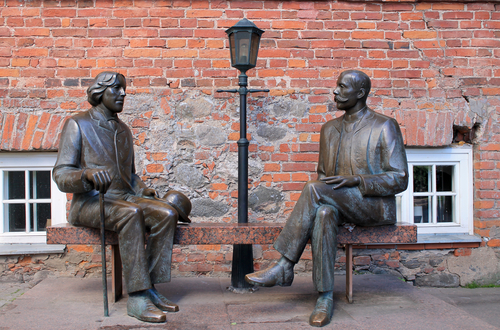
Picture: Oscar Wilde en Eduard Vilde in Tartu, Estonia: Dmitri Mehh / Shutterstock.com

Monday, 9 November 2015

The categorical imperative at work


The categorical imperative is a philosophical idea from Immanuel Kant. Kant had been wondering whether one could come up with ethical standards that would be based on pure reason, not on religious beliefs. He discovered that behaviour can be ethical if it is also generally applicable among all members of a (your) category. It is unethical if general application to all members of a category would not be considered possible or acceptable. For a street kid in Rio, stealing a bread from a rich man could still be ethical, in case you consider the rich man as belonging to a different category. Stealing a bread from another street kid however, would be unethical.

The categorical imperative is a difficult term to refer to the golden rule: don’t do to others (of the same category) what you would not like that is being done to yourself.

The question is now whether the categorical imperative is also applicable in a business context. Is there also a categorical imperative for commercial companies, or for business men who act on behalf of them? Many people will immediately say: no, because there is no mercy in business. Competition is too demanding. Applying the categorical imperative in a business context would lead to the end of the own organisation or of the person who applies it. What does religion say about the business world? The answer is simple: religions generally don't make a distinction between the personal world and the commercial world: "Respect the commandments".

If we look at the commercial world, the categorical imperative is not doing well, although companies generally try to keep a good reputation. The business world is considered as a jungle where the survival of the strongest is the only rule. Nobel Prize winner Robert Shiller claimed that companies who don’t deceive, don’t survive. The argument is often: if I don’t do it (=the evil), my competitor will do it. It is also remarkable how primitive war language is often used to describe the outcome of business meetings (battle, bloodshed, "chopped their heads off.. ").

This is the reasoning that has eventually led to the Volkswagen scandal. The same reasoning has also led to the banking crisis. We also find this reasoning in sports where athletes and cyclists have been doped to win the battle. And it is true, if we look at history, the survival logic has always been dominant where a lot was at stake in a highly uncertain (not well regulated) environment. But companies often forget the long term damage. Perhaps the categorical imperative will do better when the company environment stabilises a little and when the rules of the game get defined, imposed and accepted more widely. Until then, we will see more of these scandals.

I also refer to my earlier blog "Anständig wirtschaften".

Wednesday, 16 July 2014

Belief Creates the Actual Fact


Being convinced that something is achievable, makes it achievable. This is obvious in many cases. If you know something is achievable, you will doubt less, take more risks and go straight to the target. This is true in many types of progress, be it in personal performance or in group performance, in sports or in music, in technical innovation or in entering new markets.

But we could also revert the sentence: the actual fact creates belief. In many cases, we have belief because there is already some evidence that the goal is being achieved. Very often cause and consequence can't be clearly distinguished. They just reinforce each other.

There are goals that seem very difficult to achieve. Things like real human progress: "no more war", friendship and tolerance. Let us call it "peace". Can belief create peace? Yes, but this belief is very difficult. In that case, we can start with faith. In my language (Dutch) there is only one word for belief and faith: "geloof". This is a pity, because faith is not the same as belief. Faith is rather a combination of willingness to believe, loyalty and trust. But this Dutch ambiguity now leads me to the question if faith can create peace? Can faith create belief?

Well, it can't be proven scientifically. Historically, we can't demonstrate any real progress. In two thousand years time, we have moved as far as an asthmatic ant with a heavy load of shopping. Do we want to believe in peace? Yes, we want to believe and we should believe but at this point in time, it seems to remain a matter of faith.

Thursday, 13 June 2013

Virtues and virtutes

Virtues come from Latin "virtutes", the "man-like properties" that were useful and recognised by society. In the past, many attempts have been made to list the different virtues exhaustively or to classify them into categories. Usually Character, Courage, Humility and Generosity played some role. In ancient and Middle Age history, the virtues were often related to martial arts and knighthood.

Benjamin Franklin promoted 13 virtues to his fellow countrymen and today Tom Peters teaches us how to apply virtues in modern business life. The fact that I mention two North-American reference philosophers is not a coincidence.

Today, we have become anxious, even of mentioning virtues. We ignore them. We don't look at them and don't talk about them. We tend to surrender even before any ideal is put forward. Yet the virtues are there, even if you ignore them. Should I apologise for dedicating a blog to virtues? They could prove to be the only way out of the recession. I also refer to Anständig Wirtschaften, Generosity and Rip van Winkle.

Tuesday, 27 November 2012

Bullying: indignation is growing

Recent cases of cyberbullying have raised fierce indignation. Young people live and relive their humiliations on the Internet and decide to end their life. Kiwanis International magazine published April 2012 an article "Bullying: Why Can't We Stop It?" Kiwanis members run and support anti-bullying initiatives in schools. Prevention is necessary, because bullying is perhaps the biggest drain on manpower and talent, not only at school but also in life in general. Moreover, as work becomes more knowledge - oriented, the impact of bullying is more than ever economic in nature.

Why do we have bullying at all? Bullying is the easiest way to exert power. You terrify the weak, and automatically gain control over silent individuals, who become afraid of being bullied, and therefore start listening to the leader. It is more tempting when power boundaries are weakly defined. Hitler was a master-bully. He could never have reached absolute power without terrifying a weaker minority. Therefore, the silent witnesses are the key to the solution. Will they laugh and let this happen or will they speak up for the victims? It surely takes courage. And it requires belief that change is possible. One can start with refraining from all types of gossip. Even 'true' gossip should never be tolerated, because it is contrary to human dignity.

Today, the indignation is mainly oriented towards the bullying of children. (We should not forget adults, who know the more subtle types of bullying.) Kiwanis Leuven will be supporting the work that is being done within the Praxis-P work group of the University of Leuven. Aim is to study the effectiveness of prevention projects in local schools. Tomorrow the fund will be solemnly inaugurated.

Tuesday, 17 April 2012

Anständig wirtschaften

"Decent business" (fatsoenlijk zaken doen) would be one way of translating the title of Hans Küng's book. But the German word anständig is hard to translate in either English or Dutch. Anständig also has a connotation of "all right" (tegoei in Antwerpian), careful and diligent. The original meaning is even "not too fast", "stay there before you go".

The message of the book is not hard to guess: "why the economy needs a moral foundation". The author asks: "Was his (Ludwig Erhard's) conviction so wrong, that people can also be brought to common sense and service to the community through understanding, not only through hard laws? Is really nobody prepared to do anything on a voluntary base, only through brute force (Zwang)?"

While reading the book, other questions came up in my mind. Why do we need a stock exchange if this crazy system is not capable of damping out ridiculous panic reactions? I remember one day the Nikè index plunged because of the news of a new Japanese hostage taken in Iraq. If the system can't block this, it is totally useless and dangerous. Another question that came up: why do we allow speculation without commitment? If the value of a house or a factory increases, only the committed owners, entrepreneurs and employees should benefit from this, not the ones who buy and sell shares at computer speed while they are sleeping. I don't have the final answers yet.

The book guides the reader to the final chapter which is a manifesto signed by a number of intellectual world leaders. The preamble is as follows: "Die globalisierung des wirtschaftlichen Handelns wird nur dann zum algemeinem und nachhaltigem Wohlstand und Vorteil aller Volker und ihrer Volkswirtschaften führen, wenn sie auf die beständige Kooperationsbereitschaft und werteorientierte Kooperationsfähigkeit aller Beteiligten und Betroffenen bauen kann." In other words, the manifesto is a call on people to include all "stakeholders" in economy.

I refer to my dutch blog: het principe van de goede huisvader in een technocratie as well as to de dictatuur van de economie, written in 2004.

Monday, 26 September 2011

Seven golden rules of management

Here are 'my' seven golden rules of management:

1) Life at work is neither different from life at home nor from life in the world. One should treat others as one would like others to treat oneself. This rule is equally applicable to work, whether the other person is customer, a shareholder, a boss, a colleague, a supplier or the person who takes care of the office building. We need all of them to come to a result.

2) Conflict kills cooperation. Therefore: select objectives that are located outside of yourself, preferably to the benefit of the company, the country and ideally to society in general.

3) Stop any gossip talk, even and especially if the gossip is true. Nothing is so detrimental to success. If you wouldn't say it in the presence of a particular person, don't say it at all. When you hear it, stop it and talk about something positive. After a while, the true gossip will prove to be untrue.

4) In a hierarchical system, all information going downward, from the top to the base, is amplified by a factor of 10 per level. All upward information, from base to top, is damped by a factor of 10 per level. (Exact formula for engineers is plus or minus 10*log n decibel , where n is the number of employees per department). This implies that top people should listen very well and that base people should speak up very well.

5) Every manager should be aware that he is walking around with a shiny purple party hat with big pink letters: "I am a manager!". The manager who denies being a clown is not worthy of being a manager. Wearing a tie may only help you stay aware of your festive attire.

6) Nothing happens by itself. If you didn't think of something, probably nobody did. You can still delegate what nobody has thought of but you have to bring it up. Otherwise Murphy's law applies: the slice of bread will always fall on the 'jam' side.

7) The wisdom of the Dakota indians teaches us that when you discover that you are riding a dead horse, the best strategy is to dismount. Love your horse like yourself.

(Some inspiration came from Jeroen Bosch, Peter Drucker, Dilbert.com and manager-tools.com)

Sunday, 21 August 2011

The Knowledge-Creating Company

During my latest lovely holiday period, I decided to re-read a book that I must have read 10 to 15 years ago. "The Knowledge-Creating Company" is a book written by Japanese professors Ikujiro Nonaka and Hirotaka Takeuchi. The authors not only confirm the importance of knowledge to companies in the same spirit like e.g. Peter Drucker. They go a step further and look into the process of knowledge creation. One -often forgotten- aspect of knowledge and knowledge creation is the importance of implicit, tacit knowledge, as opposed to the explicit knowledge that can be described in patents, procedures and handbooks. This implicit knowledge is hidden, not only in the individual people's minds but also in daily practices and in the collective soul of the company.

The book is inspiring because it builds on very solid foundations: Greek wisdom, Buddhism, the highest ethical standards, the best classics of management and some Japanese spirit. Including 'just hard work' of course. It is refreshing in this time of crisis because they neither come up with popular messages nor with unnecessary controversial theses.

I was also glad to read in the flemish magazine Trends that prof. Nonaka published an article in the Harvard Business Review where he pointed out the importance of the right type of knowledge to leadership. According to Nonaka, managers are nowadays too much focused on explict knowledge and short-term advantages. The right type of knowledge needed is however practical wisdom and a general concern for company and society. It is a bit idealistic but it seems like we need it?