Showing posts with label culture. Show all posts

Tuesday, 3 March 2026

Non licet omnibus adire Luxemburgum

“Not everyone is entitled to go to Luxembourg.“ Just like Corinth in the ancient Roman time, Luxembourg enjoys a more than average prestige among the European countries/ cities today. The Luxembourgers themselves would totally disagree with this. They are convinced their country is on the contrary very accessible and open to foreigners. We don’t want to deny that; yet the Luxembourgers seem to ignore they attract a privileged class of immigrants, who contribute to and benefit from the abundant wealth in Luxembourg. Luxembourg is a country of the happy few and this attracts the happy few. The presence of this class impedes less privileged classes to find easy settlement in Luxembourg.

On this March 3rd, we spend some time to reflect on this beautiful low country in the light of Saint Cunegondis, patroness of Luxembourg. The protection she offers to Luxembourg is clearly based on a positive geographical Matthew effect. Rather than begrudge this, the surrounding countries have usually contributed to this positive evolution. Luxembourg has always promoted international cooperation in the Benelux and in Europe. Interesting is also the good internal collaboration between the political and economic actors, which led to a remarkable national industrial policy embedded in the cultural history of the country.

The language Luxembourgish is also worth mentioning. You find a famous example on the façade of a house in the old town: “Mir wëllen bleiwen wat mir sinn“. It means “We want to stay what we are”. It sounds very conservative, yet one should interpret this sentence correctly. The preparedness to change is also considered part of the Luxembourgish identity.

I refer to my earlier blog about Luxembourg.

Picture 1: Saint Cunegondis stained glass window in Luxembourg cathedral 6/12/2024 ©Wim Lahaye
Picture 2: „Mir wëllen bleiwen wat mir sinn“, house in the Luxembourg old town 6/12/2024 ©Wim Lahaye


Tuesday, 19 September 2023

The transformative power of berserker rage


The theme of anger or rage has only been discussed once in my blog. However, rage can be constructive and life-saving, because in certain cases it generates the necessary combativeness. In our country, the police were only properly reformed after the population was first inflamed in rage. We are talking about the white marches of 1996.

The Normans called that life-saving rage berserker rage. They discovered that in the heat of battle, especially when the situation was completely hopeless, they could fall into a 'level two' fighting spirit, a kind of trance in which they threw all remaining energy into the battle and in which they felt neither fear nor pain.

In fact, berserker rage is a survival instinct. A Viking warrior then turned into berserker, literally bearskin warrior (implicitly also 'without-armor' warrior) and was deemed invincible, which earned him Odin's mercy and eternal fame. In English, the expression 'to go berserk' still exists. The film Erik the Viking made use of it with the inimitable Tim McInnerny as Svein the Viking. The Normans discovered that they could also put themselves in a trance before battle with all kinds of rituals and hallucinogenic substances. But why is this berserker rage so interesting? Because it has a transformative power. It pushes boundaries. It moves the thin grey line between the feasible and the unfeasible.

Those who find themselves in a hopeless situation (e.g. of exploitation, injustice, misery, depression,..) can therefore do well to cultivate that berserker anger in order to transcend the situation and put an end to the misery and injustice. This is especially useful where the hopelessness has to do with one's own fears and one's own complacency. But beware: berserker rage is a dangerous weapon. You can only use it once and then you have to win.

Shouldn't our society also cultivate some berserker anger to get out of the negative spiral of some lingering problems? I refer to my blogs Day of Wrath and Failed State. This blog should be used with caution.

Image by Mattias Styrman from Pixabay

Tuesday, 2 May 2023

Let them be wrong about you

We may embrace the idea of not judging others; this does not immediately free us from the fear of being judged by others. Hans Christian Andersen's story of the ugly duckling reminds us of the fact that we may be excluded, simply based on the fact of being different. Being different makes us vulnerable and vulnerability may end up with injury. In the end, we become our injuries. The fear of being injured in the future may have a paralysing effect on us, even to such an extent that we proclaim a final judgement over us that is worse than the original blame. (Moreover, of all dreadful judges, you are probably the worst one for yourself.)

In the social media, we discover our fellow human beings are often wrong about many things: be it elections, climate or the meaning of woke. Even in academic circles, the reasoning of our fellow human beings is far from straight. The most educated people may end up with totally opposite opinions, depending on how their youth traumas made them look at the world. We may deeply regret this but generally we have no other option than to live with it. If our fellow human beings are wrong so often about so many things, why couldn't they be wrong about us? We do our best in the hope that humanity keeps a nice track record about us. Alas, humanity does not care.

In general, gossip, misunderstanding and stupidity may destroy our reputation in our limited social habitat. It doesn't help to be perfect: don't even try this! Instead, accept it, let it go and allow your fellow human beings to be wrong or at least incomplete about you. You rarely lose anything by allowing that to happen. People say stupid things all the time and they would have been wrong about you anyway! The happy ending is not that you become a swan, but you may feel like one! You win an enormous freedom: the freedom to be and to do what you like. You will no longer be paralysed. This can be a very liberating thought.

I also refer to another Hans Christian Andersen's fairy tale: the Emperor's New Clothes.

Picture: from the book Andersens Sprookjesschat, Zuid-Nederlandse Uitgeverij – Antwerpen/Amsterdam 1966

Tuesday, 31 January 2023

Education, Culture and Virtue

What is the purpose of education? If you gauge the zeitgeist, you think: "acquire sufficient skills to cope with global competition". That's not entirely wrong, but in "The Paradox of Ambition" we already suggested that that is not the (only) purpose of life. So there has to be more. In "The history of progress", Rutger Bregman already wrote that people did not see this as such in the past. In the past, education had to lead mainly to a virtuous life. Postmodern thinkers will suggest this was a typical vice of Christian education, where a virtuous life equalled a Christian life. But Rutger Bregman notes that original liberal thinkers such as John Stuart Mill and Alexis de Tocqueville also pleaded for the virtuous life education. Education was to bring Culture with big C and that Culture had to elevate man to a more virtuous life. It should also not be forgotten that virtue, in a society under construction, could indeed lead to a better life, especially when you consider that zeal and perseverance (the "industria" mentioned earlier) were among those virtues. Peter Drucker also mentions integrity, the virtue par excellence, as an important quality for a manager.

But today you are no longer allowed to talk about people upliftment and if you suggest that education should promote virtue, then the contemporary correct thinkers immediately start to grumble: that cannot be true! If, on the other hand, you suggest that education should improve gender equality, combat racial discrimination, and promote respect for all diversity, then everyone will applaud you. But isn't this just virtue? And isn't this virtue linked to the great Western Culture from which we think it has some unique achievements? Everything depends on how you fill in virtue and today we emphasise other things than yesterday. But virtue is necessary for a good society and it is still the best guarantee to be able to cope with global competition. And there is more: virtue is also necessary at school to come to a good study – climate.

I also refer to my blogs: "Confucius inequality ", "Pressure on Kids",  and to "Virtues and virtutes".

Picture: Giovanni Bosco dedicates his life to education - Oud-Heverlee ©Wim Lahaye

Tuesday, 27 December 2022

Ode to Friendship

Today is Saint John's day. Saint John is the patron of friendship and namesake of many good friends in many countries (Jan, Jean, John, Johan, Hans, Juan, Giovanni, João, ..). In art, Saint John is recognisable as the 'youngest looking' apostle, with long hair and a slightly feminine touch. Legend has it that he was so loved by Jesus that he became the only apostle allowed to live until his old age.

December 27 is also an ideal day to reconnect with your friends. Friends are peers in whose company we like to stay. They know us and we know them. We don't have to wear masks. We accept them as they are and they accept us as we are. However, the differences can be very large. That way, good friends can often form very strong teams. But friendship is not there to deliver great achievements.

Colleagues can become friends, but it is only when they become friends that it is a relief to be among them. In friends we recognise ourselves. We sympathize with them in the event of success or setback. Friends can compete but know no jealousy. To true friends we grant every success.

We can tolerate more from friends, but at the same time we also dare to demand more from friends. True friendship gives and asks. Friendships are often intertwined life stories. This intertwining makes the life stories fascinating and beautiful. Friendship gives colour to life.

Picture: Hans Memling - Johannes op Patmos, This is a freely licensed work, as explained in the Definition of Free Cultural Works.

Tuesday, 19 July 2022

Chariots of Fire


Chariots of fire are an ancient image in the Bible. The prophet Elisa saw his master Elijah taken to heaven by a chariot of fire when farewell time had come. The prophet Ezekiel had a vision of a heavenly chariot carried by four angelic creatures. It inspired the Swiss writer Erich Von Däniken to write his fairly speculative but highly original book called Chariots of the Gods?

The 'chariot of fire' metaphor stands for the crossing of the forbidden border between heaven and earth. Leaving this valley of tears, exceeding one’s limits, and proceeding to paradise is an ancient dream of humankind. In a certain way mankind is succeeding in fulfilling its old dream. Chariots of fire are leaving Earth every week now. Rockets are launched by the thousands. In this era of space travel, humans are lifting themselves up to the unimaginable realm of the angels.

I also refer to my blog Mir hunn e neien Feierwon, to Cosmos and to my Dutch blog De Zachte Bries over Elia.

With this blog, I also want to pay a tribute to Vangelis, who left us in his chariot of fire two months ago.

Vangelis- Chariots Of Fire - YouTube

Cosmos-Vangelis-Alpha- YouTube

THE MUSIC OF COSMOS (Soundtrak completo) - YouTube

Vangelis- Conquest of paradise - YouTube

Picture: (1) Pieter Symonszoon Potter - Het Afscheid van Elia , (2) Launch of the JWST, esa.int

Tuesday, 14 September 2021

Tobit's Confidence in the Future


Looking at 17th and 18th century paintings, you will sometimes find the theme of two young men and a dog. One of the young men has wings while the other, on his instruction, dissects a huge fish. It is the beautiful legend of Tobias and Raphael from the book of Tobit of the Old Testament. Tobit, Tobias' father, is a pious, god-fearing man, but he lives in exile, in a world hostile to his religion. Tobit relentlessly does the right thing. At night he buries the dead bodies of his deceased compatriots, although the Babylonians have strictly forbidden this. Tobit continues to do his faithful duty every night, but one day he finds himself in a completely desperate situation. A bird drops faeces on his eyes and Tobit goes completely blind. But Tobit does not lose hope; he has a strong confidence in the future and believes in the repair of the irreparable.

Tobit knows he still owns a treasure, hidden in a faraway land. Tobias has to go get that treasure with the first stranger that looks suitable to him. Tobit believes in divine Providence, and that first best stranger turns out to be a God-appointed archangel named Raphael. Raphael will guide and protect young Tobias on his perilous journey. While blessing his son for his journey, Tobit insists to him on the golden rule: “What you do not want to be done to you, don’t do that to another!”. To my knowledge it is the only place in the Bible where the golden rule is stated explicitly. The story ends well and Tobit is even cured of his blindness (see the beautiful painting by Bernardo Strozzi).

A world that denies God feels cold and hopeless. This story teaches us how we can survive and stay full of hope for a better future. In other words, trusting in God's Providence and in a better future, against all odds, is self-affirming, even when you hit the bottom of the sea. This is the only way to stay steadfast on the thin grey line between the feasible and the unfeasible.

Picture: Renata Sedmakova / Shutterstock.com, painting by J. Van de Kerhove, St.-Jakobskerk, Bruges.

Tuesday, 27 October 2020

The Legend of Sleepy Hollow

This story, originally written by Washington Irving in the 18th century, is very similar to Rip Van Winkle. It also takes place in the peaceful rural environment of Dutch colonists, in and around early New Amsterdam or New York. It is written in the same colourful English.

The village of Tarry Town or Sleepy Hollow is a place where superstition and mystery are part of daily life. It is notorious for the legend of the headless horseman, sometimes called Major André, a decapitated soldier who is believed to chase people in search of his lost head. The highly educated Ichabod Crane comes from the city and is supposed to bring reason and order in Tarry Town as the local teacher.

Ichabod falls in love with the 18-year old Katrina Van Tassel, the well-rounded daughter of a wealthy Dutch settler. He faces tough competition though, as Brom van Brunt, the local sturdy guy, also wants to court the lovely Katrina. On the dramatic evening when Ichabod asks for the hand of the lovely Katrina, he seems to be turned down and needs to drive home through the area where the headless horseman reigns. When he actually encounters the headless horseman, he rides for his life, and falls from his horse before he can reach the bridge that should have led him to safety. The story has a completely open end. It just describes the scene the next day. Only Ichabod's hat and his saddle remain. Ichabod is never seen again in the area. The scene suggests that Brom van Brunt may have abused Ichabod’s superstition to scare him off for life. (By the way, the 1999 Tim Burton movie with Johnny Depp as Ichabod Crane, doesn't follow the book 'by the book'.)

The story is a hilarious confrontation between the rational city education and the superstitious country life. This is a personal opinion, but I suspect Irving's character Ichabod is based on an acquaintance of his, perhaps even a political enemy. The 'morale of the story' is not so obvious as in Rip Van Winkle. There is a short epilogue written by Irving in which he denies there is no morale to the story. True or not: there is certainly wisdom at hand. He writes: “He who races with goblin troopers, is likely to have a rough ride.” And “He who …..loses the hand of a Dutch settler's daughter, may enjoy the preferment of the state”. The basic idea is that there is always an advantage at every disadvantage. This is a very Dutch thought...and it makes me happy.

Tuesday, 31 December 2019

Why we like Calendars

Celebrating the end of an old year and the beginning of a new year is completely preposterous if you think of it. The transition from 31 December 2019 to 1 January 2020 has little geophysical meaning for the earth, yet it seems to keep us human beings extremely busy.

The Romans indicated old-to-new transitions with the double –faced deity of Janus. One side looks at the old things behind us, the other side looks at the new things in front of us. Janus was not entirely trusted though, exactly because of this ambiguous identity. It cast some doubt over him, because of his apparent schizophrenic character.

Yet we people are all a bit like Janus. We use the calendar to position ourselves in time, to look back on what is behind us, and to look forward to what may be coming. The calendar allows us to get rid of the old, and embrace the new. It makes us forget the tears and sorrows of the past and encourages us to make new resolutions. Calendars make us dive courageously into the uncertainty of the future.

Picture: taken at Archaeological Museum Zadar, Croatia 2018 ©Wim Lahaye

Tuesday, 17 December 2019

Beethoven 250 Year

Next year, we celebrate Ludwig van Beethoven's 250th birthday. I believe Beethoven's music is the best music to introduce young people into the world of classical music. I also believe Beethoven somehow reaches  a summit in the world of music. After him, nobody reached the same level again, perhaps with the exception of Peter Tchaikovsky.

My favourite Beethoven classic is the "Pastorale", the sixth symphony. At my parents'home, we used to have a vinyl Long Play record directed by Otto Klemperer. My sister and I used to call this record: "the Rain" because the fourth movement allegro clearly sounds like a thunderstorm.

I refer to my Dutch blog: "Thank you for the Music".

Thursday, 2 May 2019

Leonardo and his Creation

Today we remember Leonardo da Vinci who died on
2 May 1519, exactly 500 years ago. Leonardo remains the most famous example of a “homo universalis”, a versatile man and a man of creativity and passion. He could pass as the man most recognised in history for having developed his many talents.

Looking at today’s company culture, Leonardo could be a role model. Today’s adage is: follow your dreams and passions, develop yourself! I sometimes call this the Steve Jobs culture. Although I support like most people the idea of self-development, this Steve Jobs culture is based on a contemporary problem and a contemporary misconception. The contemporary problem is that in larger organisations, there are only a few people who can really make free choices of their own (such as Steve Jobs) and the other 99% needs to sweat to realise these nice ideas. Even worse, the biotope of knowledge workers is far from attractive in most cases and that is why all this Steve Jobs nonsense is spreading well on the social media. Larger companies will not support multiple Leonardos, at most a single one who pulls the ropes like Steve Jobs.

The misconception is the idea that creative people are people who are doing what they like. Wrong. Creative people have a clear vision of what they would like to realise and they do everything they can to realise it, including the activities they absolutely detest. In other words, creative people aim at a beautiful result of creativity, not at the creation work itself, which is usually hard. Passion means suffering and passionate people suffer a lot during their creation work; they only enjoy the beauty of the end result. A thing of beauty is a joy forever ... once it is ready. The joy of creation is not doing what you like, it is holding in your hand what you could only imagine for so long. Creativity can’t do without patience and diligence.

I refer to “Believe in Personal Progress” and “Ode to Curiosity” and to my Dutch blog: “Imaginatio”.

Tuesday, 26 February 2019

Dunameis

Dunameis or δυναμεις means 'forces', 'powers' or 'mighty works' in Ancient Greek. You may recognise the words dynamic and dynamics. Obviously forces exist in nature, and a scientific definition exists. But the word dunameis also has an old, spiritual meaning, one that I remember very well from secondary school. The dunameis were believed to be the underlying drivers of the long history of Salvation of Mankind, as described in the Bible. They were the good forces, including the miraculous works, which were a gift from God. Contrary to what you think, miraculous works happen more often today than in the past. They are now done on a daily basis by surgeons in university hospitals.

It still makes sense to think of the meaning of dunameis today. Everything we make and do as a living being, is somehow driven by our longing for a better life. The origin of every dynamism is always suffering, we are not pleased with the status quo and want to see things change. Leaving your ‘comfort zone’ is sometimes recommended, but I wonder what this comfort zone is, and whether I will ever live in one. It is clear that ‘living’ implies striving for some kind of salvation. The Biblical meaning of dunameis seems to correspond to the forces that are driving all living creatures in this world. Religions are just ancient ways of expressing the human condition and the human dunameis within us. Our society needs to understand this and give these expressions their righteous place in society. We tend to say we don’t believe in miracles but we could still stand in awe for the dunameis we observe within us and around us.

May the dunameis be with you! I refer to my blog “a Sea of Change”.

Tuesday, 13 November 2018

The Pain of Postmodernism

Postmodernism is a 20th century war product. The central thought of postmodernism is that truth, goodness and beauty are only illusions, chased by ignorant people. Truth, goodness and beauty simply don’t exist. Every kind of veneration already carries the seed of self-destruction. This awkward idea got its power from the destructive forces of the Second World War. The War did not only destroy houses and people, it also destroyed ideas that were originally believed to be great. Postmodernism is, in a strange way, a cultivation of a permanent feeling of disappointment and many artists keep finding their inspiration in postmodernism.

An interesting question is whether postmodernism is still playing a role in today’s society and whether that role is still ‘constructive’, although a constructive postmodernism seems to constitute a “contradictio in terminis”, if not an oxymoron. In his book “History of Progress”, the Dutch author Rutger Bregman points out that postmodernism has not only been good at destroying our traditional beliefs, but also our belief in progress itself. And as “Belief creates the actual fact”, non-belief also destroys the actual fact, therefore non-belief in progress will also halt the actual progress in society.

Cultivating postmodernism, as seems to be the case now since 70 years, constitutes a certain risk of lethargy. Postmodernism has however the merit it makes us critical against all kinds of fanatic belief be it in religion or political systems. It somehow keeps us on a sane track, because all fanatic belief must be insane. A moderate degree of postmodernism is healthy as mainstream current in society, as long as we remain somehow open-minded whenever new ideas emerge.

I refer to my blog “A Sea of Change”. My blog “De donkere kamer van Damokles” covers roughly the same thoughts about postmodernism in Dutch.

Picture: Artwork “Totem” by Jan Fabre and University Library tower, Leuven. This blog is not inspired by recent press.

Sunday, 11 November 2018

New Peace Carillon

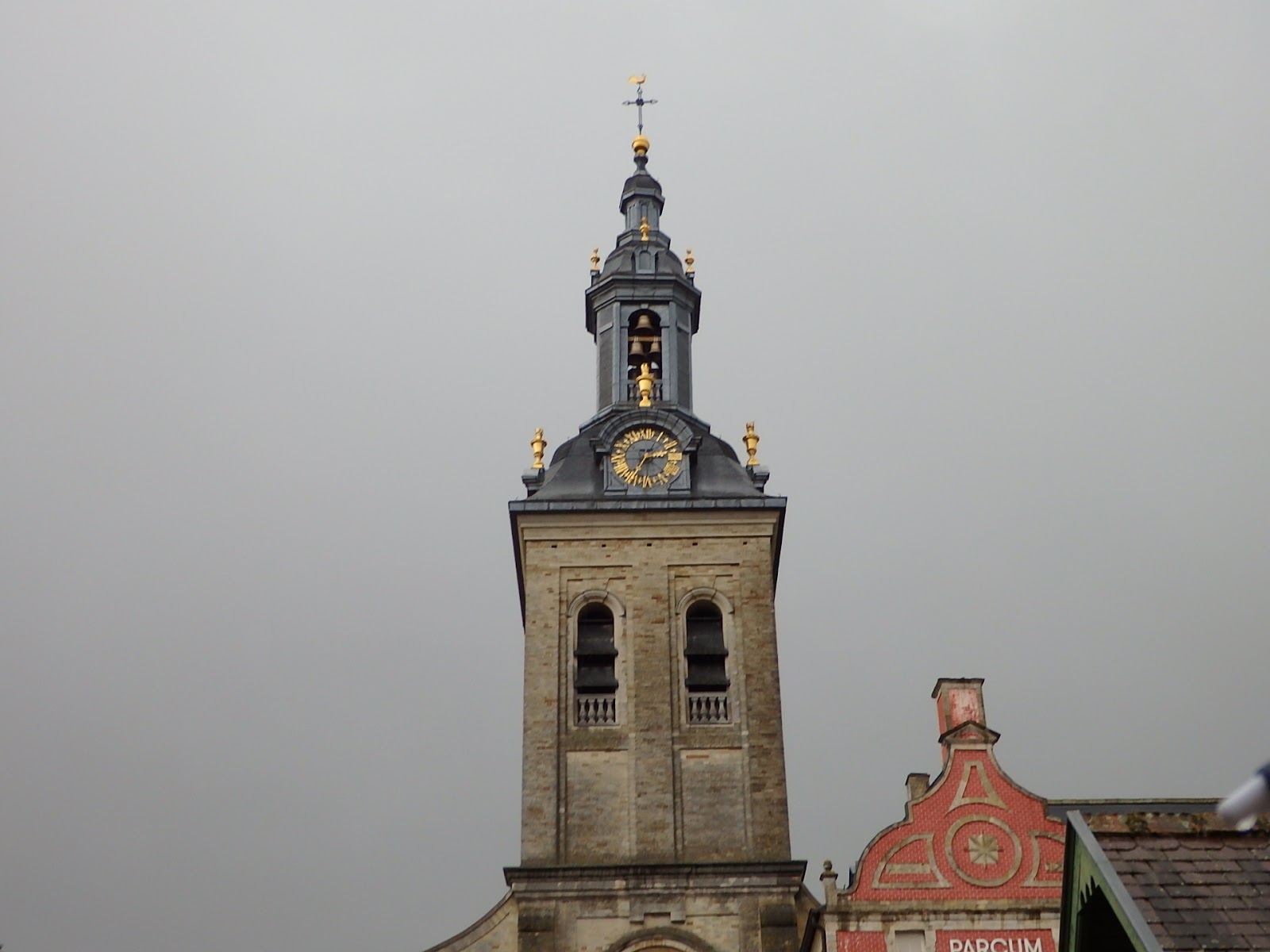
In my home town Leuven, we celebrated the 100-year end of World War I today by inaugurating a new Peace Carillon in the church tower of the Park Abbey. You need to know three things to understand why this is so important.

First, my home town Leuven was particularly hit by the violence of World War I, when a large part of town was put to fire and a lot of civilians were killed. The inauguration of the new carillon was supported by the German town of Neuss from where some of the troops had originated and with which Leuven now established good relations.

You also need to know that Park Abbey is one of the best preserved original abbey sites of its kind in the Benelux and in Europe. And like with many historic places, its history is deeply interwoven with the lives and the hearts of many local people. And you need to know that carillons belong to the nicest and finest pieces of heritage Flanders has to offer.

What is amazing on this 11 November 2018, is the incredible mobilising force from the centennial celebrations of the armistice. Most people who walked through the rain today never went through a war in their lives. I guess we all realised that our togetherness today is the best way to make clear why we want peace in this world.

Tuesday, 28 August 2018

Leaving Lazy Tasty Land


In this time of the year, we are all leaving our favourite vacation resort and returning back home. This could make us feel sad, as we face a new period of work, cold and darkness, also called wintertime. It could also make us feel sad for a totally different reason: the embarrassing feeling that maybe, we didn’t reach every destination we wanted, and maybe, even worse, we didn’t enjoy vacation time enough. In some cases, you might even raise the most prohibited of all questions: why didn’t we stay at home?

In the Middle Ages, vacation and travelling for vacation would have seemed a totally unreal activity. For most people, attending a fair at the occasion of a yearly holy day was the top of happiness. Everything beyond that belonged to the world of the dreams. The ultimate dream was the magic Land of Cockaigne, where no work needed to be done, and where food fell from the trees to eradicate all hunger. In Dutch this land was better known as “Lazy Tasty Land” (Luilekkerland). Having food and rest was considered enough to fulfil all desires; travelling would not have made any sense for the inhabitants of the Land of Cockaigne. Yet medieval people would consider today’s vacation resorts as lands of Cockaigne, as food and rest seem to be available there abundantly.

Every new year again, vacation time promises us a Land of Cockaigne, but does it also keep that promise? When we look back, we often notice that we can only enjoy vacation time in rare moments. What we do in reality is quite different from what the peasant, the soldier and the clerk are doing in Pieter Bruegel’s painting above. Let me give an overview: we burn fuel in traffic jams on the highway. We pay for using dirty lavatories, overloaded highways, scarce parking spaces and for all types of limited validity road vignettes. We get stressed from missing connections in railway stations and from unexpected strikes. We fill in forms for missing luggage and discuss visible and invisible scratches in recently hired cars. We get irritated from the selfie takers who didn't notice our intention to take that same shot. Let us thank God vacation time is almost over, and we can soon go home.

And then, amidst all the horrors of vacation, something unexpected happens. We discover a quiet place. We have a pleasant evening dinner with a glass of local wine. We take our best picture. We have an interesting chat with locals or with colleague-tourists. Then, and only then, we know why we came in the first place and why we may travel again next year. And we might recognise that travelling is a privilege, as it reveals that the magic of real places is no less than the magic of the Land of Cockaigne.

Picture 1: Land of Cockaigne by Pieter Bruegel the Elder, Alte Pinakothek, Munich. This is a freely licensed work, as explained in the Definition of Free Cultural Works.
Picture 2: Wim Lahaye, taken at Zadar, Croatia


Tuesday, 12 June 2018

The Emperor’s New Clothes


Many people know this fairy tale from the Danish author Hans Christian Andersen. Two swindlers succeed in convincing the emperor, his court and the whole country that they made magic clothes for the emperor, clothes which are invisible for stupid, incompetent people. All countrymen are afraid to be unmasked as stupid and stand in awe for the emperor’s new clothes. Except one little boy who was unaware of the magic property of the clothes and shouts in the crowd that the emperor is not wearing any clothes at all.

We may identify ourselves with the cheering people, who turn with the wind when suddenly everybody else does. This is the so-called mainstream. We should identify ourselves with the emperor. No one really escapes from the position of the emperor. Our idleness and fear of appearing stupid continuously blackmail our reason. This doesn’t happen occasionally, it happens continuously. We are forced to live a life of rational denial and self-deceit as we are blackmailed by others on our intellectual capacities. This, in a certain way, tells us something about society as a whole. Our society is trapped in a number of self-constructed paradigms. Some of these paradigms are absolutely foolish. We don’t question them as we don’t want to be considered a fool. How can we get rid of these paradigms? We need to listen to ignorant little boys and girls.

Let me give some examples of foolish paradigms. We all believe that working from nine to five is actually a smart thing to do. We drive ourselves, always at the same time into massive traffic jams. Is that so smart? All these office jobs, are they really so meaningful that we all have to be there at the same time? Is it really needed that we all drive hundreds of kilometres, daily, alone, crossing thousands of people who do the same in the opposite direction? When vacation time starts, we drive ourselves into traffic jams on the highways to the south, every year again. Is that a smart thing to do? Or we take the plane and spend our precious free time in front of security gates at the airport? I want to be the little boy who says this is not smart.

The Emperor’s New Clothes  was wonderfully narrated and sung by Danny Kay in his movie Hans Christian Andersen and it was recorded for eternity on this wonderful vinyl record, which I remember so well from my childhood. Enjoy the song.

Picture: from the book Andersens Sprookjesschat, Zuid-Nederlandse Uitgeverij – Antwerpen/Amsterdam 1966

Tuesday, 7 November 2017

The Siren Songs of Simplicity


In Greek mythology, the Sirens were believed to be beautiful women who attracted ships with their singing to the coastline. Once the sailors got fascinated by the Sirens, they could not resist steering their ship onto the deadly cliffs. The Sirens constitute an appropriate cultural metaphor for the ease with which people can be tempted to listen to simple messages and choose for their own destruction. Masses tend to behave in a very simplistic way. Anyone who has been giving speeches on festive occasions, knows that crowds of people only react on simple basic jokes (crude subjects like alcohol and sex) and very rarely on delicate intellectual jokes. The same preference for basic simplicity explains recent voting behaviour in a number of countries.

Why are masses so attracted to simplicity? Essentially because it liberates them from the painful duty to think and to doubt. In the midst of dangerous ship manoeuvres, the easy shortcut is always more attractive than the long, difficult route, which raises unbearable tensions among the crew. Sometimes the certainty of destruction is more attractive than the agony of continuous debate. Populist politicians know this instinctively. On the other hand, I hesitate using the word populist here, because the word is losing its meaning due to the overuse by politically correct writers.

In times of chaos, humble and patient leaders often give the impression of being weak leaders. They think a lot about consequences and ethics. They negotiate and talk. Pretentious impatient leaders can then easily lead the people astray with simple, basic slogans or messages, nowadays mostly packed as tweets, less than 140 characters long. Black or white messages are easier to understand than grey, nuanced messages, which require more time to generate and to digest. But the black and white messages may lead us to the cliffs.

Good captains don’t listen to Sirens, even if the crew starts listening to them. Ulysses ordered his men to tie him to the mast of his ship, so that he could not be seduced to act according to the godly sound of the Sirens. Good captains are often wrong in the short term; they may get right in the long term. The problem with our democracy is that the election terms are too short; the long term never happens without coalition change. Our political system kicks out the good captains and replaces them regularly by simplistic ones. Let us blame it on the Sirens.

Other blogs related to group behaviour are: “Tulip Mania”, "Mainstream versus Democracy" and “Senatores boni viri”.

Thursday, 16 February 2017

Why my Home Town Leuven is Worth a Visit

This is a blog for globetrotters, colleagues from other countries and other planets. I just want to give you a few reasons to visit my home town Leuven. Leuven is around 25 kilometers east from Brussels. It is internationally well-known through its university to students and researchers, but as a touristic destination, it is still a little underrated. I’m not chauvinistic, only proud in the good sense. Let me know when you are coming.

The most convincing place of interest is probably our town hall, which I already compared with the Brussels town hall in a previous blog.


Next to it, the Saint Peter's church, built around the same time, has a marvellous interior and contains some treasures of art, like 'the last Supper' painting by Dirk Bouts.


Our Grand Beguinage is a favourite place to stay for professors and students.

One of my favourites is Saint Michael's church in the Naamsestraat, a rare perfect example of Jesuit baroque style. In this church, you can visit the tomb of the famous scholar Leonardus Lessius (Lenaert Leys).


Next to it, you will find the Premonstratensian college where professor Georges Lemaître, the 'creator-inventor' of the concept of the Big Bang, used to have his office.


The university library was already shown in a previous blog.


The university is a blessing for the town, as it created excellent hospitals and research centres.

There are many more things to see in and around Leuven, and you will certainly see some of them in my future blogs, as I regularly use self-made pictures to illustrate my texts.

Thursday, 22 December 2016

Tulip Mania


The Tulip Mania was een economic bubble in in the trade of tulip bulbs in and around the town of Harlem in Holland in the seventeenth century.

Tulip bulbs and purchase options on tulip bulbs became as expensive as a series of houses along the main street. The Tulip Mania reached its peak when the exchange course of the tulip bulb crashed on the 3rd of February 1637.

People tend to claim this was unexpected - not true. A citizen of the town of Hoorn wrote a clear warning “Claere ontdeckingh der dwaesheydt” ("clear discovery of folly") . Today we have the paintings of Jan Bruegel the younger and of Hendrik Gerritszoon Pot as testimonies. you can admire both paintings in the Frans Hals museum in Harlem.

Such collective folly is, sadly, very recognisable. The question is, however, why man behaves like a herd beast. One rich neighbour is usually convincing enough to try it. Even worse, it is the one who doesn't participate in the folly who is declared mad. It is worth considering what else is today's collective madness? You are kindly invited to name a few as a comment to this blog.

Anyhow, the behaviour of masses is unreliable. Never follow a mass without criticism. This must have been the birth of Socrates' wisdom.

I refer to my blog: "Senatores boni viri" and to my Dutch blogs: ”De Waanzin van het Intellect” and “Lof der Zotheid”.

Picture: Tulip Mania - Jan Bruegel the younger

Monday, 24 October 2016

Utopia - Thomas More


In 1516, exactly 500 years ago, Sir Thomas More published his “Utopia”, actually a seafarer’s story in which an ideal society is portrayed. Utopia, ancient Greek for “no-place” or nowhere, is a word that stands since then for the society we can only dream about, but which we will never be able to realise. It is worth reading the Utopia, the society vision is surprisingly modern. In Utopia we find equality between all people, education for men and women, six hour working days, distribution of wealth based on needs rather than on power, selection of public officials based on competence and an early vision on social security.

There is yet another reason why the Utopia is so interesting. We have lost the capability of dreaming and imagining. Yet you need a vision if you want to move forward. Whether it is at the political, the economic or the social level, we need new visions on how our society could work in the future. This would also make sense at a more technical level, where we urgently need to improve our urban planning and construct ‘smart cities’, so that our quality of life can become acceptable again. (I believe it is not acceptable today.)

As the first “Utopia” was printed on Dirk Martens’ press in 1516 in my home town Leuven. I can recommend you to come and visit the wonderful Utopia exhibition in the town museum and in the university library (picture).

I refer to my more extensive Dutch blog “Utopia - Thomas More”, written 4 years ago.