Showing posts with label family. Show all posts

Tuesday, 2 January 2024

A New Year’s Resolution: Cultivate the Art of Being There


Most New Year’s Resolutions emphasise action or abstinence. We should do more or less of something. We should do more sports, more language learning and more hobbies. We should smoke less, work less and drive our cars less.

Instead of our actions, we could also consider our presence in this world. Are we really there for our loved ones? Do we spend time with them and how do we spend our time with them? How is our attentiveness towards our loved ones? Do we really listen and talk with full attention? We do not always need to speak, but are we receptive to the expressed and non-expressed needs of our fellow human beings?

In many cases, we can’t solve all problems and it is not good to overact. The essence is to be there. This sounds like a tautology. We need to be present when our loved ones need us. Let us get rid of our full agendas and live in the here and now.

Tuesday, 8 February 2022

Bemoaned Benefits of Boredom

How long is it since you experienced boredom? If you are fifty and still at work, I guess it is a very long time ago. You may remember you experienced as a child the endlessness of time and the sadness of not knowing what to do. On the other hand, you may also remember the benefits of boredom: silence, time, quietness and peace of mind.

All this is no longer possible, due to our social web addiction. If by accident, we get a rare spare moment we immediately waste it on our smartphone or computer. In this way we can only get bored by the nonsense of others. This is a sad thing. It is as if we are afraid to discover our true self.

The loss we experience in this way is the loss of the fruits of boredom. The fruits generated by silence, time, quietness and peace of mind. These fruits are curiosity, creativity, erudition, spirituality and patience. These fruits of boredom bring us much closer to our fellow human being than the superficial hyperactivity displayed in postmodern times on the worldwide web.

Let us change something in our lifestyle.

Picture: Knalfestival exposition KU Leuven library ©Wim Lahaye

Tuesday, 21 May 2019

The Pursuit of Attention


In 2019, the pursuit of happiness has become a pursuit of attention. You may have food and clothes, a good health, a house with a garden and some security. If you feel like you don’t receive or ‘deserve’ attention, you will be unhappy. In this time of Beschleunigung and Social Web Addiction, when everybody chases his self-defined goals at 120 km/h and 10Mbit/s, attention has become the most pursued good, the holy grail of happiness.

In the world of politics and media, attention makes and breaks careers. In the world of work, companies no longer need hard-working people or smart people, they need people who spend all their attention to work and it has become a challenge to identify the ones who do. In education, the children have not become lazier or more rebellious, it just has become increasingly difficult to attract their attention, due to the thousands of stimuli and opportunities they need to process each day. We see a lot of kids that are of good will, but they are dropping out because of a lack of attention from their parents and their teachers.

Relationships between friends, partners, parents and children can only be nurtured through mutual attention. Attention is love and love is attention. But attention requires time and energy, so we have to get our priorities right! With this blog, I once again show I’m good in theory. Practice in family life however proves that “we” usually fail towards the ones we love most. It is rare that one regrets not having answered a remark from a remote Facebook friend. After answering a thousand remarks from remote Facebook friends however, we may regret not having paid attention to our partner, our children or our parents. And finally, it can even happen that we don’t pay enough attention to ourselves.

A special kind of paying attention is attentiveness, a very useful virtue in social life. I also refer to my blog: You are your Time

Picture: zijkant Beursgebouw Brussel ©Wim Lahaye

Tuesday, 8 May 2018

Hygge or hyperactivity?


The word Hygge became popular in Denmark to indicate a Danish flavour of cosiness and relaxing lifestyle. It can be a social sense of togetherness -spending time together-, or it can be a more solitary version with books, sofas, fireplaces, cats and cups of tea. Hygge expresses a kind of well-being, of harmony with other people without looking at the clock. Hygge may well be the opposite of hastening and hyperactivity.

Hygge was originally a Norwegian word, which meant something like consoling or comforting. It is related to an English word we all like: to hug: to embrace, literally: to build a fence or form a hedge ('haga') around someone. (The word Hygge is therefore etymologically related to my family name Lahaye.)

It is clear that there is a growing market for Hygge. We have all become restless and hyperactive. The reason may be the earlier discussed Beschleunigung of life. Hyperactivity brings us in a vicious circle. It creates restlessness and stress. We long so much for rest that we become restless in trying to achieve it. We can’t even wait for anything anymore. As soon as we are kept waiting, we take our smartphone and make other people wait for us.

Let us be restless in fighting hyperactivity and let us leave no opportunity unused to bring more Hygge in our daily life, be it with colleagues or with family members. Let us get rid of the smartphone and let us hug our dearest and nearest a little more. I refer to my earlier blog Lifestyle.

Tuesday, 20 September 2016

The Course of Love

Writing about love (the Greek Eros, the love between partners for life) is as difficult as the subject is. Alain de Botton writes about love by means of a concrete love story, a maturing relationship between two people. As a professional philosopher, he still analyses nevertheless, almost in forensic detail, what happens in a typical relationship in the 21st century. But his analysis is not cold, on the contrary, it is warmhearted and compassionate. His deep-digging considerations aim at helping his 21st century readers develop another view on the things that may torment them in daily life. I can imagine that many people like myself, seek comfort in his wise books, with the sole purpose of releasing themselves from the unfeasible expectations our culture imposes on us.

The author pinpoints some contradictions in our romantic view on love. The unreasonable importance we assign in our culture to the early moments of love, whereas we somehow ignore the romance of later life. There is also the role of coincidence and freedom in the establishment of a relationship, which is somehow contrary to the idea of “a good match” and the heavy commitment we make when we get married.

Another problem is the fact that we don’t recognise sufficiently the glory of the daily duties of family life (“spoon yoghurt into small mouths”). When also children come into play, it is clear that the expectations on husband and wife, two totally different, vulnerable creatures, can become cruel and unbearable. In his ironic style, the author comes to the conclusion that our romantic view on love is actually a recipe for disaster. “Coping” with the cruelties of everyday life is in the end the only realistic basis for a maturing relationship.

I marked a few sentences to remember, the ones about children were particularly hilarious.
  1. “An ability not to care too much is a critical aspect of unruffled and successful pedagogy.”
  2. “It is a wonderful thing to live in a world where so many people are nice to children. It would be even better if we lived in one where we were a little nicer to the childlike sides of one another.”
  3. "…, if they weren’t his own children, they would strike him as being unremarkable, so much so, that were he to meet them in a pub in thirty years’ time, he might prefer not even to talk to them. The insight is unendurable.”
  4. “…children, a class of beings constitutionally uninterested in the daily satisfactions of those who created them.”
Vulnerability and acceptance are keywords in relationships. Alain de Botton comforts the tormented modern citizen, who can’t stop feeling hurt by the daily triumph of the fools around him.

Other comforting books from the same author are:  Status AnxietyDe Troost van de Filosofie and Ode aan de Arbeid (the Pleasures and Sorrows of Work). I also refer to Time and Energy in Households.

Wednesday, 4 February 2015

Social web addiction


Social web addiction is a real plague. We experience it everywhere, even at work meetings. Some people start surfing on the social web as soon as they see the chance. They don't look up if you talk to them. You need to send them an e-mail or a chat sentence for them to react. This addiction is not different from other addictions like smoking. It is annoying for the people around and it is even annoying for the addicted person himself. The addicted person needs more strength to stop than to continue and the weakest characters suffer more from addiction than the strongest. Note that 40 years ago, television addiction was a major source of concern for parents and it still exists today, with or without internet addiction on top of it.

Why do we get so addicted? It is not so much because we learn so many new things. We do it because we are social beings. We seek recognition. The advantage of the social web is that recognition becomes quantifiably visible in number of connections, recommendations, likes and comments. This also nurtures our narcism though. The social web gives us the impression we are important and relevant. We seem to tell important things and the other people are there to read all this. The problem is that we all have the same asymmetric, egocentric view. The most important content on the web is always our own. (In this case my blog, that you may read.)

Why is social web addiction a problem? It is not a problem because the social web is more superficial than the "real" world. The social web is just as real and just as superficial as the world we knew from before the social web. In fact, the social web is a mirror image of the "real" world. In daily  talk, we are also narcistic. In the "real" world (whatever that may be), we also believe our "content" (talk) is the most important and hardly listen to what other people have to say.

The true reason why social web addiction is a problem is that the people who are physically around us (children, parents, neighbours, direct colleagues) don't get enough attention. This is a problem if they are not part of our web discussion groups.

What is the solution? I believe we need to create time limits and we need to create routine. Suppose you could force yourself not to go on the social web before all your homework is done. Suppose you would be aware that web surfing in a meeting is impolite to the meeting organiser. Suppose you could force yourself never to do two things at the same time (especially if driving a car is one of them). Suppose you could always stop your social web activities at 10:00 PM. Suppose you would never go on the social web more than once per day. I guess you could turn a lot of time in quality time. You would not be frustrated about missing the things you would not have liked anyway.

I also refer to my earlier blogs: you are your time , raising kids in the 21st century and netwerkverslaving.

Sunday, 31 August 2014

You are your time


Time has become an extremely valuable good. In this time of "Beschleunigung" - acceleration, we have to spend our time in a responsible way and we may have to justify our time use to our boss, our family members and to ourselves.

What we spend our time on, will be highly dependent on our identity, including our hierarchy of values. We may spend time to our job, to our partner and our children, to our hobby or to contemplation. But we may also lose time in traffic, or lose time on the internet reading and writing a lot of Facebook idleness.

Our identity determines our time use. We have to be aware, however, that the opposite is also true: our time use determines our identity. Therefore, an important question is: does my time use reflect my identity, does it reflect the person I want to be? If not, I am actually a slave and should be doing something else.

Most people complain they spend too much time at work and on the Internet in general and not enough to family. I rarely hear people say they spend too much time with their children. I also rarely hear people say they don't spend enough time on Facebook. In general, we tend to do too much activities that keep the mind restless and the body inactive. We don't spend enough time on children, parents and neighbours, activities that keep the body active and appease the mind.

It means we do not truly master our time, we have become the slave of time consuming addictions. Internet addiction has become a real threat for education. It is an addiction comparable to alcohol or tobacco addiction. This addiction is not totally new; television addiction is a problem reported already 40 years ago. But the level of interactivity and instant rewarding (likes) of the Internet brings the information addiction to the next level. The challenge in educating the next generation is to learn the children to master their time. We can only do this if we master our time ourselves. So let me stop here and spend some time with the children...

Saturday, 2 November 2013

Lifestyle


Everybody would agree the work - life balance got lost somewhere. The new occupational diseases are called burnout and depression. Reported solutions range from mindfulness to low calorie diets. What is going on? We talked ourselves into a value system that is oppressing and depressing. And although we know it is wrong, we persist in evil.

1) This evil value system makes us recognise our fellow human being because of his merits and his performance only, and not because of the human being he really is. In biblical language, we could say we are obedient to the Mammon; we adore something that is not worth adoration. We think we are respectful, but we only show respect to the winner of the rat race. Our children need to be perfect and we need to be perfect, but our perfectionism only aims at our outer performance not at our entire human being. Meritocracy, the Frankenstein monster that we created ourselves, holds us in its claws.

2) The speed of traffic and media disturbs our sense of reality. Our expectations prove to be unrealistic all the time. We deny our limitations rigorously. It is a sin of hubris.

3) Efficiency is everything. Beauty needs to step aside for function and performance. Never in history has fashion been so contrary to beauty.

4) We don't recognise the small things in life. We don't make time neither for each other, nor for anything unimportant. It is always good to make a little walk and talk to the neighbour. Let us please reintroduce Sunday silence. I refer to my previous blogs time and energy in households and meritocracy is merito-crazy.

Monday, 9 September 2013

Travelling is a privilege


Travelling is a privilege and it should remain one. I don't mean to say not everybody has the right to travel. But looking back at the time the happy few started travelling for pleasure, the time of the Great Continental Railway Journeys, we have come a too long way.

Now, too many people travel too far without solid reason or motivation. It is not funny anymore. On the highways, you end up in traffic jams, worse than any traffic jam in the working months. In the airports, you stand queues for ages, and hope nothing goes wrong with the ticket computer. At the monuments, you may also have to queue to obtain a ticket or a terrible lunch for your kids. Why do we all need to see Australia? We hardly know the good places in our own towns, let alone the history. Travelling in the summer months is becoming a nightmare. Let us please stay at home.

Who should travel then? Of course, the ones who really need it for their work. Secondly, those who really deserve travelling. They have worked hard and are prepared to pay their expensive trip. These can't be spoiled youngsters without any working record. Neither can it be people who have already had a good life in wintertime, without contributing to society (to the extent possible). Let us make travelling a little more for the happy few, like it was in the old days. This is good for the environment; it is good for the travelers and it is good for the ones who should learn to live with a little bit less. Don't consider this blog as a total rupture with my earlier demonstrated social concern.

I would rather refer to earlier green blogs heat, Durban and love miles.

Tuesday, 15 January 2013

Time and Energy in Households

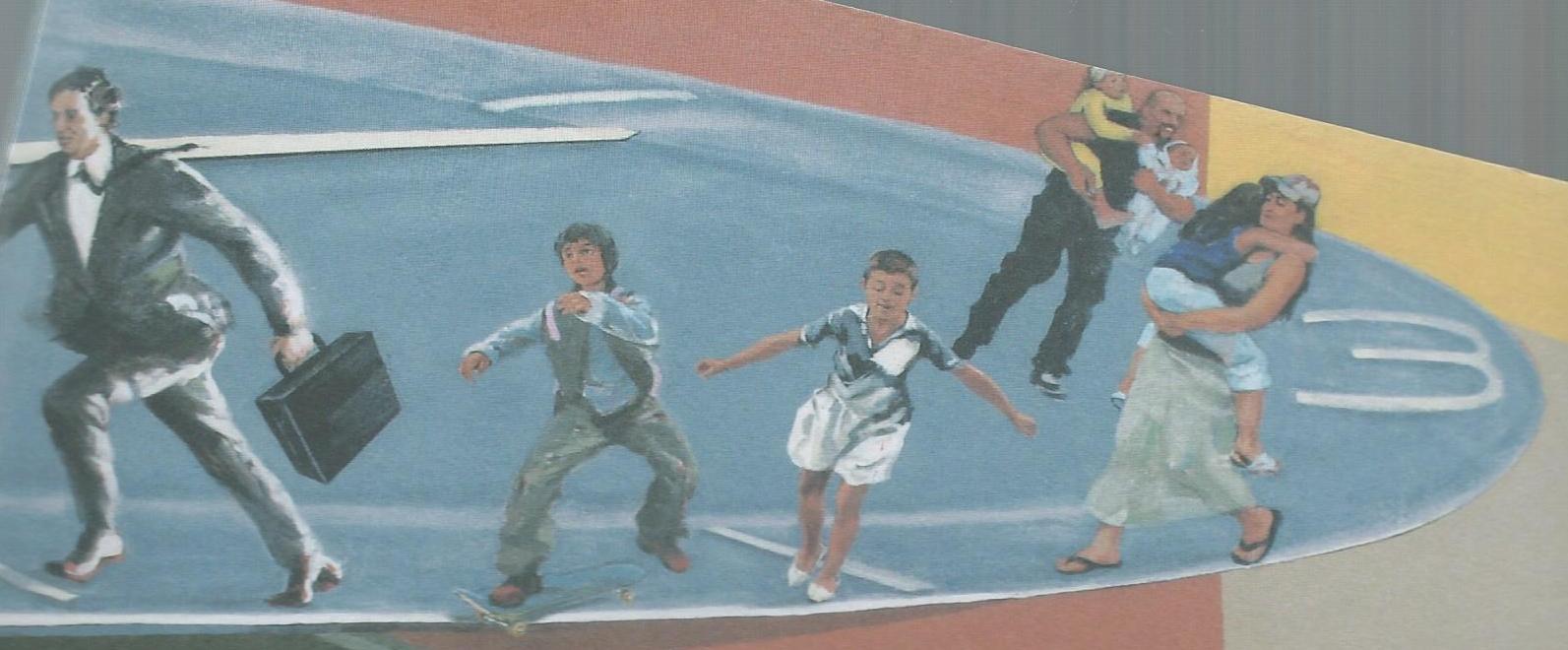
Picture: mural by artists Nora Theys & Gerard Alsteens at HIG

When you talk to modern parents about their concerns, the main complaint is lack of time and energy to get everything done in the household, from practical stuff, like cooking, washing and cleaning to helping kids with homework, bringing them to school activities and getting the house in good order.

In many or most households, both husband and wife have a job. The strain of work is already high. On top of that comes daily traffic in the rush hours. The concern to get the children safe at home. Kids often go to multiple side activities. They need to be the best.

Moreover, many houses are very expensive and yet poor quality. Whether they are old or new, there are usually many problems to be solved before everything is in good order. This is not new, but it is not easy to find affordable help or you need to do everything yourself.

Household costs also tend to rise faster than household income, so more and more households are facing a difficult time. Fortunately grandparents tend to live longer, so they can help if they are living in the vicinity. But this is not the case with everyone. Moreover, if you are struck in your household by a problem like chronic disease or loss of a family member, you can end up in deep trouble.

I'm still convinced society is putting too much strain on the households. The centrifugal forces have become too high and divorces have increased spectacularly. Yet the households are raising the children who will work for our retirement in the future. They deserve a little more attention.

I also refer to my earlier blogs 'raising kids in the 21st century' and 'meritocracy'.

Sunday, 18 September 2011

Meritocracy is merito-crazy

It is good to be aware of this. We live in a meritocracy. We are told we deserve to be what we are. If we go well, it is our merit. If we go bad, it is our own fault. The positive outcome of meritocracy is that it makes us work and that is good. But it is essentially based on a lie. We are not what we deserve to be. If we go well, it is not our merit. And if we go badly, it may be our own fault, but it usually isn't.

Why do I tell this today? Well, this morning, the gospels brought us the parable of the workers in the vineyard, one of my favourites. This parable basically tells us that God is against meritocracy. He rewards us according to our needs, not according to our merits. And if we go well, it is essentially by grace, not by merit.

Moreover, also 'secular' philosophers like Alain de Botton have pointed out that today's extreme meritocracy causes status anxiety and destroys happiness. The truth is: we have much less control over our lives than we think. If we don't go too well, we should do our best, but we shouldn't be blamed. And if we go well, we should recognise how lucky we have been to get there.

So we should admit that the waves of fortune are somewhat beyond our control. Management thinkers should also recognise this. Let us get rid of our merito-craziness.