Absinthe is a police thriller by Guido Eekhaut. The scene is located in the Low Countries, in the cosmopolitan cities of Amsterdam and Leuven.
It is a story about Russian oligarchs, cold-blooded murderers, right-wing politicians and corrupt policemen, typical ingredients of a Saturday evening whodunit on television and I don't see why this story could not become the script for a television thriller. The plot is certainly solid enough to start with.
The main character Walter Eekhaut is the archetype of the stubborn policeman with unconventional methods (somewhat like Inspector Morse). The author sketches several parallel story lines in short chapters, picturing several individual colourful characters. He then brings these lines together in unexpected events that somehow ignite the story, so that you will not easily stop reading. It was a good idea of the writer to serve this story with a glass of Absinthe as this brings in real warmth and taste into the story.
To enjoy all finesses of the unexpected, the reader needs a certain understanding and feeling for rules and procedures that might be applicable in an international police context. Although the author educates his reader in this sense, the lay reader may miss the unexpected in the denouement and at this point the author might have been too demanding of his readership.
The hardcover edition I bought looks and feels very nice and I could not spot a single error in the text.
Slender Man is a book by the same author. You will find an equally good plot and a similar background view on society, but the narrating technique used in Slender Man is quite different.
Tuesday, 20 November 2018
Tuesday, 13 November 2018
The Pain of Postmodernism
An
interesting question is whether postmodernism is still playing a role in today’s
society and whether that role is still ‘constructive’, although a constructive
postmodernism seems to constitute a “contradictio in terminis”, if not an
oxymoron. In his book “History
of Progress”, the Dutch author Rutger Bregman points out that postmodernism
has not only been good at destroying our traditional beliefs, but also our
belief in progress itself. And as “Belief
creates the actual fact”, non-belief also destroys the actual fact,
therefore non-belief in progress will also halt the actual progress in society.
Cultivating
postmodernism, as seems to be the case now since 70 years, constitutes a
certain risk of lethargy. Postmodernism has however the merit it makes us
critical against all kinds of fanatic belief be it in religion or political
systems. It somehow keeps us on a sane track, because all fanatic belief must
be insane. A moderate degree of postmodernism is healthy as mainstream current
in society, as long as we remain somehow open-minded whenever new ideas emerge.
I refer to
my blog “A
Sea of Change”. My blog “De
donkere kamer van Damokles” covers roughly the same thoughts about postmodernism in Dutch.
Picture: Artwork
“Totem” by Jan Fabre and University Library tower, Leuven. This blog is not inspired by recent press.
Labels:
culture,
essay,
philosophy,
society,
spiritual
Sunday, 11 November 2018
New Peace Carillon
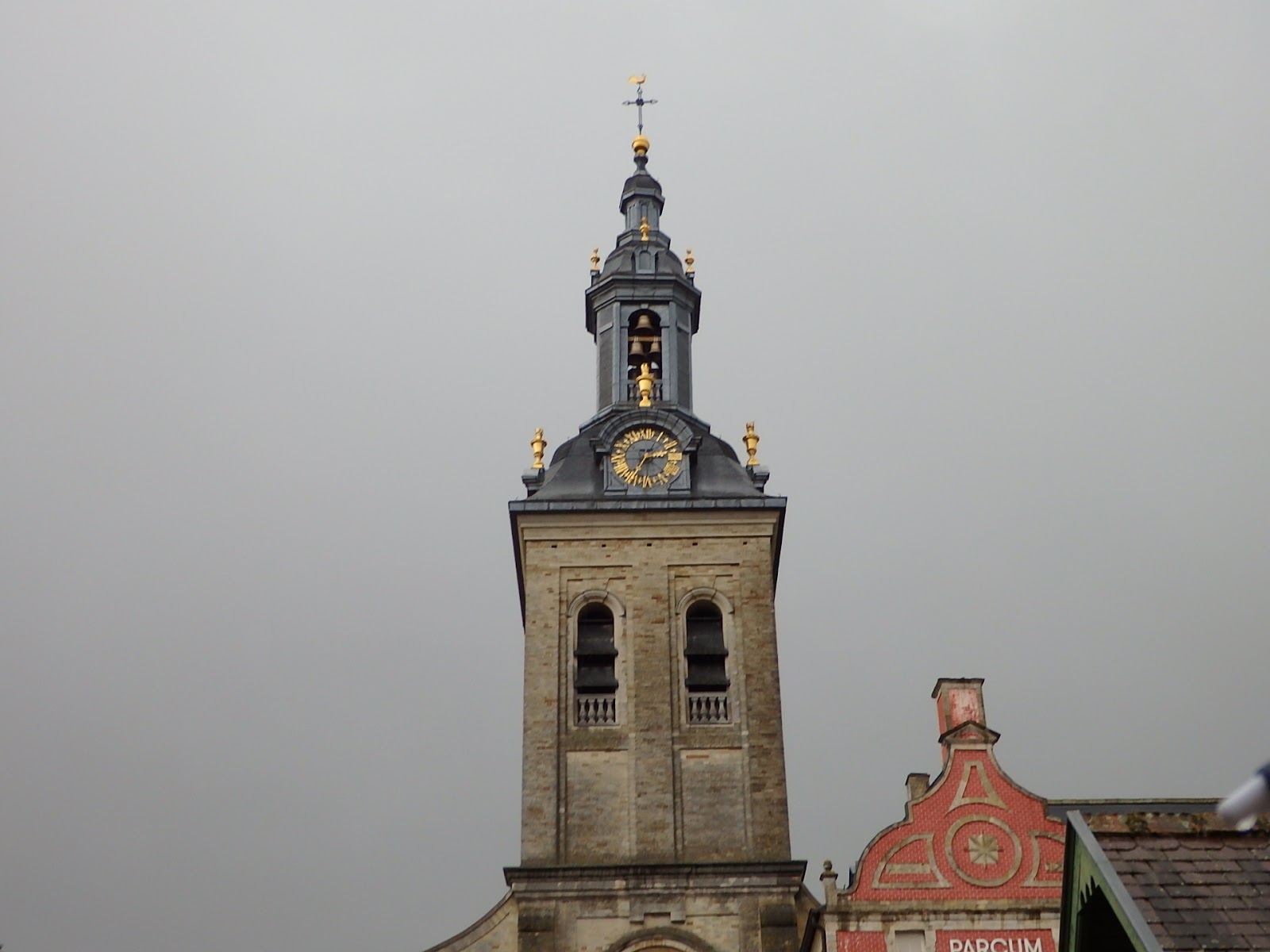
In my home town Leuven, we celebrated the 100-year end of World War I today by inaugurating a new Peace Carillon in the church tower of the Park Abbey. You need to know three things to understand why this is so important.
First, my home town Leuven was particularly hit by the violence of World War I, when a large part of town was put to fire and a lot of civilians were killed. The inauguration of the new carillon was supported by the German town of Neuss from where some of the troops had originated and with which Leuven now established good relations.
You also need to know that Park Abbey is one of the best preserved original abbey sites of its kind in the Benelux and in Europe. And like with many historic places, its history is deeply interwoven with the lives and the hearts of many local people. And you need to know that carillons belong to the nicest and finest pieces of heritage Flanders has to offer.
What is amazing on this 11 November 2018, is the incredible mobilising force from the centennial celebrations of the armistice. Most people who walked through the rain today never went through a war in their lives. I guess we all realised that our togetherness today is the best way to make clear why we want peace in this world.
Location:
Abdij van Park, 3001 Leuven, België
Tuesday, 30 October 2018
What They Don’t Teach At School .. Yet
When you
read a title like this on a social web site, you can expect a truckload of cynical advice from people with bad experience and a bad character. This is obviously not the case
here.
In fact,
school should become less cynical, not more. School tells pupils how to behave,
but doesn’t tell them what to do if others don’t behave. As such the strong
guys are told that they should not bully the weak, but the weak guys are
never told what they should do in case they are bullied. "Go to the teacher or
headmaster", is a good advice from the point of view of the adults, but we
remember quite well it didn’t work very well in the old days either. The issue is
important, because school performance is in my honest opinion, more often
affected by lack of a safe study climate than by a lack of intelligence. In
her book Dreamers
who do, Hilde Helsen mentions three basic skills all children should become
familiar with at school:
- They should teach all children the principles of non-violent communication. Non-violent meaning here: not based on humiliating arguments of power, but based on arguments of perceived behaviour. In the Bible, the fraternal admonition is recommended. You should talk "under four eyes", and if that doesn’t work, you should get one more witness. If that doesn’t work, go to old wise men. The strong should be confronted with their weakness, and the weak should be confronted with their strengths.
- All children should be taught some type of meditation: yoga, mindfulness or transcendental meditation. In the old days, we had prayer. It is now a lost type of meditation because we became too idle and too proud to believe we could need it.
- All children should recognise compassion as a universal human feeling and a universal human value. Compassion is neither an emotion to be ashamed of, nor an obligation that is imposed by one or the other religion.
Tuesday, 18 September 2018
Political Paralysis by Polarisation
If you live
in a prosperous country, you are probably unhappy. Partly because your salary
is no longer increasing, but also because your society is divided over the
question whether to share that prosperity with newcomers or not. In the US, you
may be in favour of Trump or against Trump. In Britain, you may be in favour of the
Brexit or not. In Sweden you may be in favour of the Swedish Democrats or not.
In Germany, France, Belgium, there is a deep trench between traditional parties
and the so-called ‘populist’ parties. Not a single country
escapes and the entire political system gets polarised about the issue.
The cause
of the polarisation is obviously: we don’t succeed well in integrating the newcomers.
While the newcomers already have a social backlog and tend to live in ghettos,
the original inhabitants work themselves to death to stay ahead of them. Two
camps exist: those who believe there is no work/ integration possibility left for newcomers and
those who believe that humanity needs to prevail. The press tends to reduce the
problem to a problem of racism. At both sides of the trench through society, people accuse the other side of being immoral.
People draw
the wrong lesson from World War II. We see the War now as a fight between good and evil. That is because we can watch the 1930 - 1945 years with the eyes of someone who
lives in 2018, knowing what happened after 1930. We believe we know what was an
appropriate moral conduct in 1930, but we forget that the people of 1930 lived
in an uncertain world, just like we do today. People of 1930 believed an
appropriate moral conduct was to fight communism. Why ? Because communism was
believed to be dangerous. Just like we think we know what is dangerous today.
Some believe ethnic nationalism is dangerous and some believe the Islam is dangerous.
Who is right? We can’t say, because this is a question about the future.
I believe
therefore that the best moral conduct possible is to stop with this polarisation and admit that we don’t know
what is dangerous. We can only say extremism is dangerous because it leads to violence. We should not be naive and tolerate anything from those who
don’t behave properly. But we should plead for dialogue with the ones who seem to
have an opinion that is different from ours. We should stop digging trenches and start taking more risks. It takes courage to do that. The real victims of this polarisation are the ones who live in precarious circumstances: the refugees including the trans-migrants and the original inhabitants of the poorer suburbs.
I refer to
my Dutch blogs about polarisation
and Christmas
2016.
Location:
1143, Luxemburg
Tuesday, 28 August 2018
Leaving Lazy Tasty Land

In this
time of the year, we are all leaving our favourite vacation resort and returning
back home. This could make us feel sad, as we face a new period of work, cold
and darkness, also called wintertime. It could also make us feel sad for a
totally different reason: the embarrassing feeling that maybe, we didn’t reach
every destination we wanted, and maybe, even worse, we didn’t enjoy vacation
time enough. In some cases, you might even raise the most prohibited of all questions:
why didn’t we stay at home?
In the
Middle Ages, vacation and travelling for vacation would have seemed a totally
unreal activity. For most people, attending a fair at the occasion of a
yearly holy day was the top of happiness. Everything beyond that belonged to
the world of the dreams. The ultimate dream was the magic Land of Cockaigne, where no
work needed to be done, and where food fell from the trees to eradicate all
hunger. In Dutch this land was better known as “Lazy Tasty Land”
(Luilekkerland). Having food and rest was considered enough to fulfil all desires; travelling would
not have made any sense for the inhabitants of the Land of Cockaigne. Yet medieval
people would consider today’s vacation resorts as lands of Cockaigne, as food
and rest seem to be available there abundantly.
Every new year again, vacation time promises us a Land of Cockaigne, but does it also keep that promise? When we look back, we often notice that we can only enjoy vacation time in rare moments. What we
do in reality is quite different from what the peasant, the soldier and the
clerk are doing in Pieter Bruegel’s painting above. Let me give an overview: we burn
fuel in traffic jams on the highway. We pay for using dirty lavatories, overloaded
highways, scarce parking spaces and for all types of limited validity road vignettes.
We get stressed from missing connections in railway stations and from
unexpected strikes. We fill in forms for missing luggage and discuss visible
and invisible scratches in recently hired cars. We get irritated from the selfie takers who didn't notice our intention to take that same shot. Let us thank God vacation time
is almost over, and we can soon go home.
And then,
amidst all the horrors of vacation, something unexpected happens. We discover a
quiet place. We have a pleasant evening dinner with a glass of local wine. We take
our best picture. We have an interesting chat with
locals or with colleague-tourists. Then, and only then, we know why we came in
the first place and why we may travel again next year. And we might recognise
that travelling
is a privilege, as it reveals that the
magic of real places is no less than the magic of the Land of Cockaigne.
Picture 1: Land of Cockaigne by Pieter Bruegel the Elder, Alte Pinakothek, Munich. This is a freely licensed work, as explained in the Definition of Free Cultural Works.
Picture 2: Wim Lahaye, taken at Zadar, Croatia
Picture 1: Land of Cockaigne by Pieter Bruegel the Elder, Alte Pinakothek, Munich. This is a freely licensed work, as explained in the Definition of Free Cultural Works.
Picture 2: Wim Lahaye, taken at Zadar, Croatia
Tuesday, 10 July 2018
The Art of the Good Life
This book carries the ambitious subtitle “52 Simple Shortcuts
to Happiness”. When I
see such a title in a book shop, I usually look away and don’t touch it. The
book may fit well in a typical American book store. People may believe I can’t
manage my own life and I may need help.
I had
however heard at work of the author Rolf Dobelli and his first book “The Art of
Thinking Clearly”. When you open the book, you notice the chapters are short
and beautifully illustrated with colourful drawings. It contains a lot of
simple but wise advice and it easily invites to further reading.
The book is
written from a ‘high society’ perspective and some examples given may not appeal
to everyone. With some of the 52 recommendations, you might even disagree, but
I bet most people will agree with at least 48 out of 52 recommendations. I discovered that the joy of reading is also related to the fact that you were
already aware of some of the pitfalls of postmodern life and you might even
have taken measures already to overcome them.
You will
find some of these pitfalls/ recommendations in previous blogs “The
Delusion of Immanent Justice”, “Status
Anxiety”, “Meritocracy”,
“On
Optimism and Pessimism”. This book is a good Swiss army knife for a good life.
Subscribe to:
Posts (Atom)